
- Kanmon and Parafin are not the same product. Parafin underwrites from its own balance sheet using historical GMV data. Kanmon is an API layer that connects platforms to a network of third-party lenders.
- For usage-based platforms where revenue is irregular, Parafin’s GMV-based underwriting model is a stronger fit because it reads transaction velocity rather than requiring fixed revenue history.
- Kanmon gives platforms more control over loan product design and lender selection, which matters if you need customized terms or want to white-label the experience more deeply.
- Neither company publicly discloses pricing. Both require a sales conversation before any cost structure is visible.
- The decision comes down to a single variable: do you want to outsource the credit risk entirely (Parafin) or maintain architectural control over which lender holds that risk (Kanmon)?
Parafin is the better default for usage-based platforms that process high transaction volume, because its underwriting engine reads GMV patterns directly without requiring stable monthly revenue figures. Kanmon is better for platforms that want to customize loan products, white-label the borrower experience, or route deals to specific lenders. If your platform has irregular revenue cycles and you want a fast integration with minimal credit infrastructure to build, choose Parafin. If you are building a differentiated financial product with specific lender relationships in mind, choose Kanmon.
Why Most Platforms Misread This Decision
The common assumption is that embedded lending APIs all work the same way: you call an endpoint, a borrower gets approved, you clip a fee. Kanmon and Parafin share that surface-level description, but their underlying architectures create completely different operational realities for the platform running the product.
Parafin operates as a balance-sheet lender. It takes the credit risk itself and uses the transaction data flowing through your platform to underwrite businesses. Kanmon operates as a marketplace infrastructure layer, connecting platforms to a network of licensed lenders who actually hold the loans. That distinction determines who controls underwriting criteria, how quickly you can launch, and what your revenue share looks like.
For platforms with usage-based revenue models, specifically those where sellers or merchants have volatile monthly revenue but predictable GMV trends, the balance-sheet approach tends to win. A lender looking at 12 months of consistent GMV growth can approve a business that a traditional underwriter would decline on cash flow grounds alone.
How Does Parafin’s Underwriting Model Actually Work?
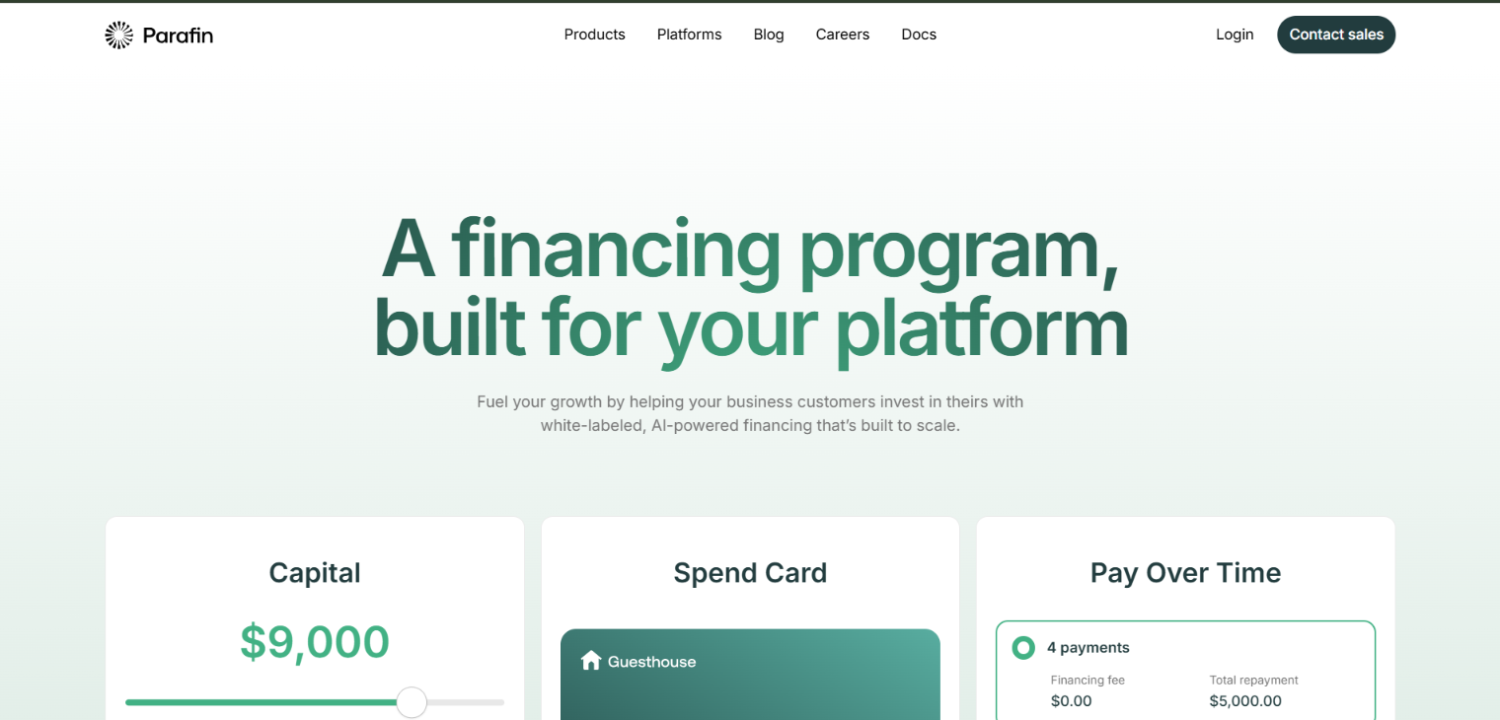
Parafin was built specifically for platforms. Its core product is a cash advance or loan offer generated from the transaction data your platform already collects. According to Parafin’s public documentation, the company uses GMV history on your platform to generate pre-qualified offers for your merchants or sellers, meaning borrowers see an offer already calibrated to their actual performance rather than submitting a cold application.
This matters most for usage-based platforms because the underwriting model reflects how those businesses actually operate. A marketplace seller doing $60,000 in GMV during peak season and $15,000 in the off-season looks unreliable to a traditional lender. Parafin sees the seasonal pattern and prices around it. The same logic applies to gig platforms, creator platforms, and any SaaS product where customer revenue correlates with platform activity rather than a fixed subscription.
Repayment is structured as a percentage of ongoing revenue processed through the platform, which removes the fixed monthly payment pressure that strains seasonal businesses. Parafin takes on default risk directly, which means the platform does not need to build collections infrastructure or manage loan performance reporting.
How Does Kanmon’s Lender Network Model Work?
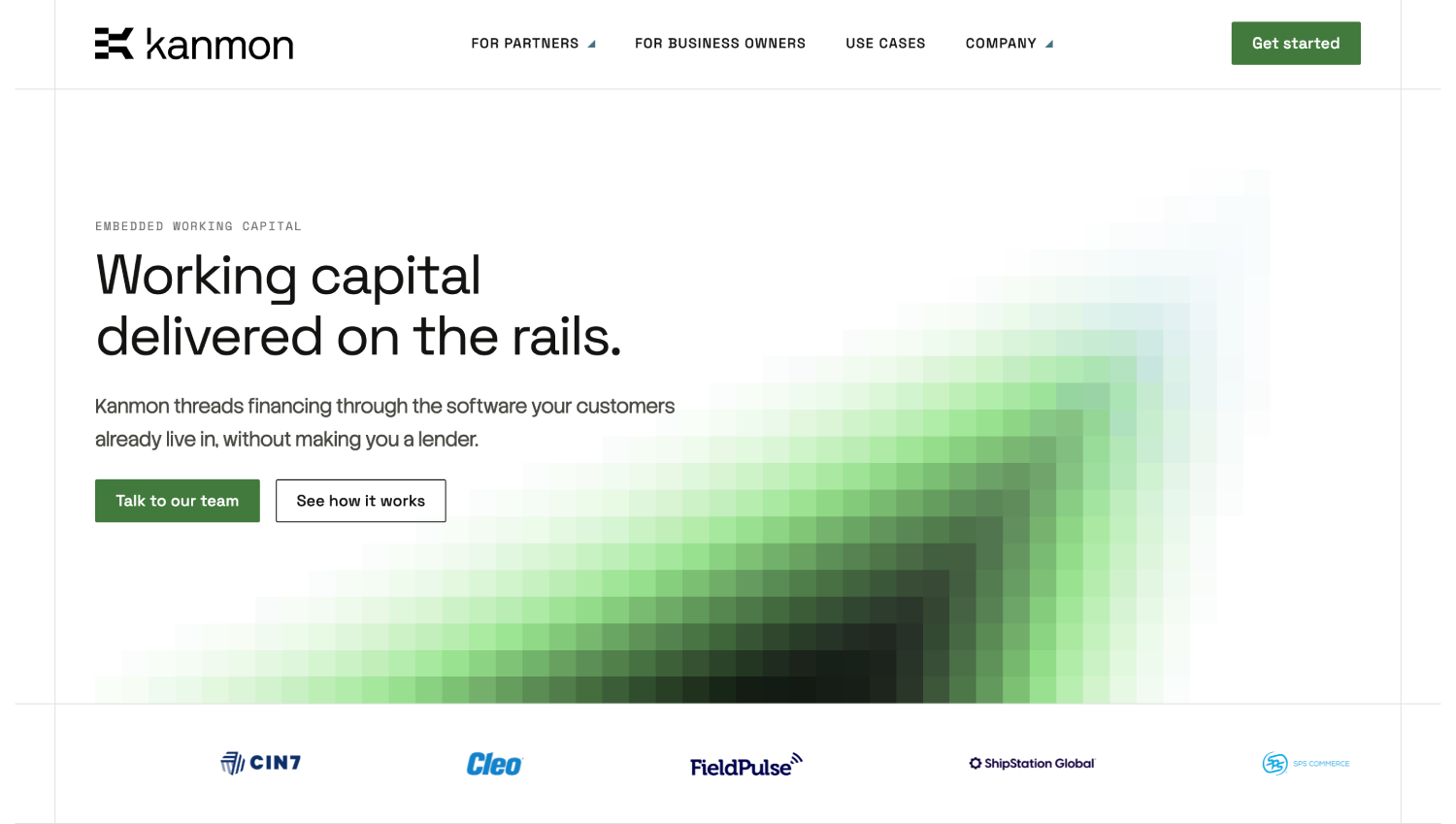
Kanmon positions itself as embedded lending infrastructure rather than a direct lender. Platforms integrate the Kanmon API, configure their loan product, and Kanmon routes applications to lenders within its network who compete to fund deals. According to Kanmon’s public product documentation, the platform supports multiple loan types including term loans, lines of credit, and receivables financing.
The architectural implication is that Kanmon’s credit decisions come from the lenders in its network, not from Kanmon itself. That gives platforms more flexibility in theory, because different lenders may accept different borrower profiles. In practice, it also means the underwriting criteria are not fully within the platform’s control unless they negotiate specific arrangements with individual lenders.
Where Kanmon has a clear advantage is in white-label customization. Platforms can build a lending product that looks and feels native, with their own branding, their own loan product naming, and their own borrower-facing experience. For platforms building financial services as a core differentiator rather than a peripheral feature, that level of control is worth the additional integration complexity. For more context on how embedded credit APIs compare across product types, the top embedded credit API providers for B2B platforms covers the broader field.
Kanmon vs Parafin: Feature and Architecture Comparison
| Dimension | Kanmon | Parafin |
|---|---|---|
| Credit model | Lender marketplace (third-party lenders hold risk) | Balance-sheet lender (Parafin holds risk) |
| Underwriting data source | Application-based, supplemented by platform data | Platform GMV and transaction history |
| Loan products supported | Term loans, lines of credit, receivables financing | Revenue-based cash advances, working capital loans |
| Repayment structure | Fixed schedule (lender-determined) | Percentage of ongoing GMV processed through platform |
| White-label depth | High , full borrower experience customization | Moderate , co-branded or Parafin-branded UI |
| Platform liability for defaults | None (lender holds risk) | None (Parafin holds risk) |
| Best for usage-based platforms | If product customization is the priority | If speed to offer and GMV-based approval is the priority |
| Integration complexity | Higher , multi-lender routing requires configuration | Lower , single integration, Parafin handles underwriting |
| Pricing model | Not publicly disclosed | Not publicly disclosed |
| Revenue share to platform | Negotiated per deal | Revenue share on funded volume |
The Usage-Based Platform Stress Test: A Framework for Choosing
At FintechSpecs, we apply what we call the Platform Lending Fit Test to embedded lending decisions: four questions that expose whether a vendor’s architecture matches the platform’s revenue model before you sign a partnership agreement.
Question 1: Does your borrower base have stable monthly revenue?
If the answer is no, GMV-based underwriting is not a nice feature. It is a prerequisite for meaningful approval rates. A gig economy platform where sellers earn $3,000 in one month and $400 the next will see most of its merchant base rejected by lenders relying on traditional income verification. Parafin’s model addresses this directly. Kanmon’s model depends on which lender you route to and whether that lender accepts GMV-based signals.
Question 2: Do you need loan products beyond working capital?
Revenue-based advances are the right tool for cash flow gaps. If your merchants need equipment financing, longer-term credit facilities, or receivables-backed credit lines, Parafin’s current product set may not cover those use cases. Kanmon’s multi-product architecture gives access to a broader set of loan structures through its lender network. For platforms building a comprehensive financial services layer, that breadth has real value.
Question 3: How important is the borrower experience to your product differentiation?
If lending is a loyalty feature and not a core revenue line, a co-branded or lightly customized experience is fine. Parafin’s integration model works well here. If your platform’s competitive position depends on owning the financial product experience end-to-end, Kanmon’s white-label capability is worth the integration overhead. Consider how your embedded lending API choice affects your product roadmap before committing to either architecture.
Question 4: What is your time-to-launch constraint?
Parafin’s integration is operationally lighter because the underwriting logic lives entirely with Parafin. You send transaction data, Parafin generates offers, you surface them in your UI. Kanmon requires more configuration because you are effectively setting up a lending product with its own loan parameters and routing logic. If you need to launch a working capital feature in under 90 days, Parafin is the lower-friction path.
What Does Parafin Capital Actually Cost?
Parafin does not publish pricing as of the date of this article. The company’s revenue model is based on a share of interest and fees charged to borrowers on funded loans, with the platform receiving a portion of that revenue. The exact split is negotiated during the partnership agreement and varies by platform size, GMV volume, and product configuration.
For platforms, the cost structure is favorable because there is no upfront technology fee disclosed publicly. The platform earns revenue on loans it did not underwrite and does not service. The trade-off is that Parafin sets the pricing floor for borrowers, so the platform has limited ability to compete on cost if a merchant wants a cheaper alternative.
What Does Kanmon Embedded Lending Actually Cost?
Kanmon also does not publicly disclose pricing as of the date of this article. The economics flow differently from Parafin’s model. Because lenders in Kanmon’s network are competing to fund deals, the interest rates available to borrowers can vary based on lender appetite at any given time. The platform typically earns a referral fee or revenue share on funded volume, though the specific terms require a direct sales conversation.
The operational cost for the platform includes integration engineering time, which is likely higher than Parafin given the multi-lender routing configuration. That is a one-time cost that needs to be weighed against the long-term revenue and product flexibility benefits.
A Worked Scenario: Two Usage-Based Platforms, Two Different Answers
Consider a two-sided marketplace with 800 active sellers, average monthly GMV of $4,000 per seller, and high seasonal concentration in Q4. Most sellers have inconsistent revenue months but demonstrably growing GMV trends over 18 months. This platform wants to offer working capital to keep sellers stocked heading into peak season. Parafin is the clear choice here. The GMV trend is exactly the signal Parafin’s underwriting reads. Sellers get pre-qualified offers without a traditional application, approval rates should be materially higher than a standard lender would produce, and the platform earns revenue share without building any credit infrastructure.
Now consider a vertical SaaS platform serving 300 independent contractors in the construction industry. Revenue per user is usage-based on project hours logged, but the platform also wants to offer equipment financing and short-term project loans with terms ranging from 30 to 180 days. The product needs to carry the platform’s branding and match the platform’s UI design system. Kanmon’s architecture fits better here because the loan product variety, white-label control, and lender network can accommodate construction-specific loan structures that a revenue-based advance product would not support.
The two platforms have similar revenue models but completely different product requirements. That is why vendor identity matters more than category identity in this decision.
Which Platforms Are Each Provider Best For?
Parafin is best for:
- Marketplaces and platforms with high GMV but irregular seller revenue
- Gig economy platforms where income varies week to week
- Platforms that want a fast integration without building underwriting logic
- Teams that want to earn revenue from lending without taking on credit risk or operational overhead
- Platforms where working capital advances are a retention feature, not a core product
Kanmon is best for:
- Platforms building lending as a primary financial product with distinct branding
- Platforms that need multiple loan types beyond revenue-based advances
- Teams with engineering capacity to configure a more complex multi-lender integration
- Platforms serving borrowers who may qualify with some lenders but not others, requiring routing logic
- Vertical SaaS products where the lending experience needs to match the platform’s design and product standards exactly
How Do Kanmon and Parafin Handle Compliance?
Both providers handle state lending license requirements through their own or partner arrangements, which is one of the primary reasons platforms use embedded lending APIs rather than building direct lender relationships. The compliance burden of maintaining lending licenses across multiple states is a meaningful cost and operational risk that neither platform offloads to you. For a clear map of what fintech compliance infrastructure actually costs by stage, the real cost of compliance in fintech SaaS breaks it down concretely.
Parafin, as the direct lender, holds the regulatory relationship with borrowers on its own paper. Kanmon’s model means the individual lenders in its network hold those relationships, which can create variation in borrower experience depending on which lender funds a given deal. For platforms operating in heavily regulated states or serving higher-risk borrower segments, understanding which entity is the lender of record matters for your own regulatory exposure.
Are There Meaningful Kanmon Alternatives or Parafin Alternatives?
Both vendors compete in a space that includes Pipe, Capchase, and newer embedded working capital products from payment infrastructure companies. The best embedded working capital APIs for B2B platforms covers the broader competitive set including Pipe and others in this category. For platforms specifically evaluating revenue-based financing providers, the leading revenue-based financing providers for SaaS and ecommerce adds additional context.
The primary reason to look at Kanmon alternatives is if your lender requirements are highly specific and Kanmon’s network does not include a lender that matches your borrower profile. The primary reason to look at Parafin alternatives is if your platform’s GMV volume is too low to generate statistically meaningful underwriting signals, in which case Parafin’s model may produce thin approval rates regardless of how the integration is configured.
Frequently Asked Questions
Is Kanmon or Parafin better for embedded lending on usage-based platforms?
Parafin is generally better for usage-based platforms because its underwriting reads GMV and transaction history directly, which produces higher approval rates for businesses with irregular but growing revenue. Kanmon is better if the platform needs customized loan products, deeper white-label control, or access to multiple lender types beyond revenue-based advances. The right answer depends on whether the platform is optimizing for approval rate and speed to launch, or for product flexibility and borrower experience control.
Does Parafin take credit risk away from the platform?
Yes. Parafin funds loans from its own balance sheet and retains the default risk. The platform earns a revenue share on funded volume but does not hold any exposure to loan performance. This is one of Parafin’s key structural advantages for platforms that want lending revenue without the operational complexity of managing a loan portfolio or a collections function.
Does Kanmon require the platform to take on credit risk?
No. Kanmon routes deals to third-party lenders who hold the credit risk. The platform is not the lender of record and does not carry default exposure. The platform earns a referral fee or revenue share on funded deals, similar to Parafin’s model, but the lender relationships and risk are distributed across Kanmon’s network rather than concentrated with a single balance-sheet funder.
What is the minimum platform GMV required to work with Parafin?
Parafin does not publicly disclose a minimum GMV threshold. The company’s underwriting model requires sufficient transaction history to generate statistically reliable offers, which suggests platforms with very low or very new GMV may see limited approval rates. This is a question to raise directly in a Parafin sales conversation before committing to the integration.
Can Kanmon support multiple loan types on a single platform?
Yes. Kanmon’s public product documentation describes support for term loans, lines of credit, and receivables financing, which gives platforms access to a broader set of loan structures than a single balance-sheet lender typically offers. The specific loan types available depend on which lenders within Kanmon’s network are active and willing to fund deals on your platform.
How long does it take to integrate Parafin vs Kanmon?
Neither company publishes specific integration timelines. Parafin’s model is operationally simpler because the underwriting logic lives entirely within Parafin. Kanmon requires more configuration because of the multi-lender routing architecture. In general, platforms with limited engineering resources will find Parafin’s integration path lower-friction. Platforms with engineering capacity and complex product requirements may find Kanmon’s flexibility worth the additional build time.
Do Kanmon or Parafin publish their pricing?
Neither Kanmon nor Parafin publicly discloses pricing as of the date of this article. Both companies require a direct sales conversation to receive pricing terms. Revenue share arrangements in embedded lending typically vary by platform GMV volume, loan product type, borrower risk profile, and the specific terms negotiated at contract signing.
The Single Lens That Resolves This Decision
Most platform teams frame this as a features comparison. It is actually a credit architecture decision, and the right framing is: do you want the underwriting model to be built around your platform’s transaction data, or do you want to route borrowers to lenders and let the market decide?
Parafin answered that question for usage-based platforms by building an underwriting engine that treats GMV as the primary signal. That is not a feature, it is the entire product thesis. For platforms where sellers or merchants generate meaningful, trackable transaction volume, Parafin’s model converts more of that activity into approved loan offers than any application-based system will.
Kanmon’s answer is different and not wrong. Platforms that need more than working capital, that want to own the borrower experience more completely, or that have borrower segments requiring specific lender matches should not force those requirements into a model that was not designed for them. For those platforms, Kanmon’s lender network and product flexibility are the right trade-off. The decision is architectural before it is commercial, and getting the architecture wrong creates a product you will be rebuilding in 18 months. For a broader look at where embedded lending sits within the full fintech infrastructure stack, the complete fintech infrastructure stack map shows how these products connect to the rest of the platform.