
- Embedded finance is not just payments. It covers cards, accounts, lending, compliance, and orchestration, and each layer requires a separate infrastructure decision.
- The API you choose early shapes your compliance obligations, margin structure, and how fast you can ship new financial products later.
- Stripe, Marqeta, Unit, Plaid, Adyen, and Kanmon each dominate different segments. No single provider is best across all six categories.
- Most SaaS companies underestimate the regulatory surface area they inherit when they embed finance. That cost shows up in legal fees, onboarding friction, and churn, not just integration time.
- The right starting question is not which API has the best docs. It is which financial product your users need first, and which provider gives you a compliant, extensible path to add more.
The best embedded finance APIs for SaaS companies in 2026 are Stripe (payments and card issuing), Marqeta (card program control), Unit (banking and accounts), Plaid (data connectivity), Adyen (global payments and acquiring), and Kanmon (B2B lending). The right choice depends on which financial product you are embedding first, your compliance readiness, and whether you need a single provider or a multi-vendor stack.
Why Embedded Finance Is an Infrastructure Decision, Not a Feature Decision
Most SaaS founders come to embedded finance thinking about a single feature: add a payment button, issue a card, let users hold a balance. That framing leads to bad vendor choices. A payments API you bolt on in week one becomes the foundation everything else is built on.
When you embed a financial product, you inherit a portion of the regulatory surface that comes with it. Card issuing brings KYC obligations. Holding customer funds requires either a banking license or a partnership with a sponsor bank. Lending triggers state-by-state licensing requirements in most US jurisdictions. None of this is visible in a developer quickstart, but all of it affects your legal budget, your onboarding completion rate, and your liability exposure.
The vendors that abstract this complexity best are not always the cheapest or the fastest to integrate. That trade-off is what this guide is built to surface. If you have not already mapped your compliance obligations before picking a vendor, the Fintech Product and Compliance Readiness Checklist is worth reading before you proceed.
What Categories of Embedded Finance APIs Exist?
Embedded finance breaks into six functional categories. Most vendors specialize in one or two of them, even if their marketing suggests otherwise.
- Payments APIs: Accept, route, and settle money. Examples: Stripe, Adyen, Braintree.
- Card issuing APIs: Create and manage virtual or physical debit and credit cards programmatically. Examples: Marqeta, Stripe Issuing, Lithic.
- Banking and accounts APIs: Offer FDIC-insured accounts, ACH, wires, and balances under your brand. Examples: Unit, Synctera, Treasury Prime.
- Lending APIs: Embed B2B or consumer loan origination, underwriting, and servicing into your product. Examples: Kanmon, LoanPro, Peach Finance.
- Data and connectivity APIs: Link user bank accounts, verify identity, and pull financial data. Examples: Plaid, MX, Finicity.
- Orchestration and compliance APIs: Route transactions across multiple rails, handle KYC/KYB, and manage fraud. Examples: Unit21, Sardine, Alloy.
A SaaS company building expense management needs cards and accounts. One building a marketplace needs payments and possibly lending. One building a B2B vertical SaaS needs accounts, cards, and compliance tooling. The category you start in largely determines which vendors are worth evaluating.
How to Evaluate an Embedded Finance API Before You Commit
Three criteria matter most: regulatory coverage, pricing structure, and extensibility. Everything else, documentation quality, sandbox availability, API design, is table stakes in 2026.
Regulatory coverage means the vendor either holds the licenses you need or has sponsor bank relationships that cover your target geography. A vendor that is great for US-only card issuing may be completely unsuitable if you plan to expand to Canada or the EU within 18 months.
Pricing structure determines whether embedded finance is a margin driver or a margin killer for your business. Some vendors charge per card issued, some take interchange, some charge a platform fee plus transaction fees. These models compound differently at scale. The hidden costs that compress fintech SaaS margins often come from pricing models that looked cheap at 100 users and looked brutal at 10,000.
Extensibility means the API can support the next financial product you add, not just the first one. Locking into a vendor that handles payments but not accounts means a second integration project, a second compliance review, and a second set of customer-facing onboarding flows when you expand.
Which Embedded Finance APIs Are Best for Payments?
Stripe
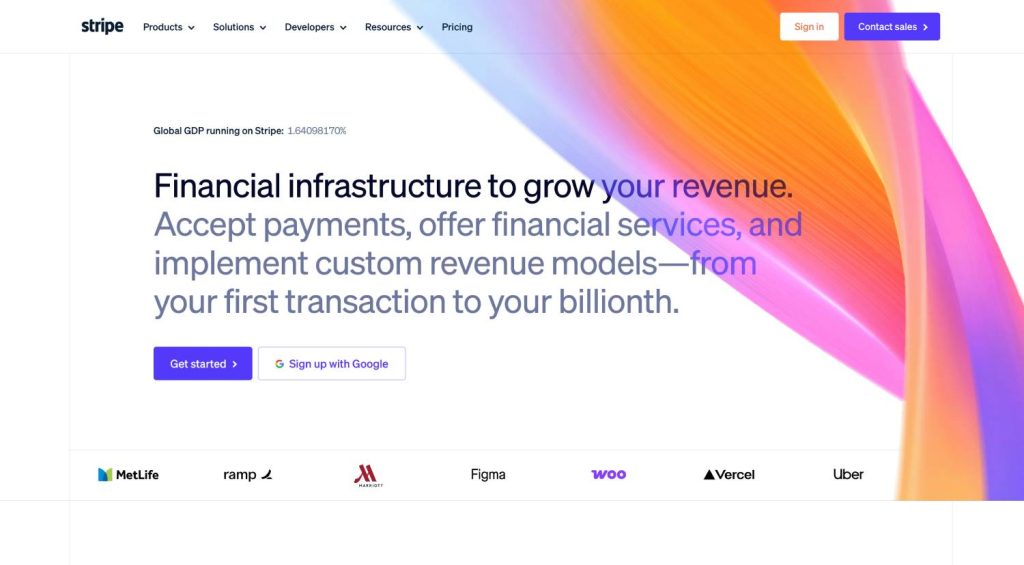
Stripe is the default choice for embedded payments in SaaS, and that reputation is earned. Its Stripe Connect product handles multi-party money movement, making it well suited for marketplaces and platforms that need to split payments between a platform and its merchants or service providers. Stripe Treasury extends this into banking, allowing platforms to offer FDIC-insured accounts and ACH transfers under their own brand.
The pricing model is public and transparent. Standard card processing is 2.9% plus $0.30 per transaction as listed on Stripe’s pricing page, with custom rates available at volume. Treasury and Connect pricing involves additional per-transaction and per-account fees that Stripe publishes in its documentation.
Stripe’s weakness is negotiating power. At seed or Series A volumes, you take the standard rates. Adyen or Braintree become more competitive once you are processing tens of millions of dollars annually.
Adyen
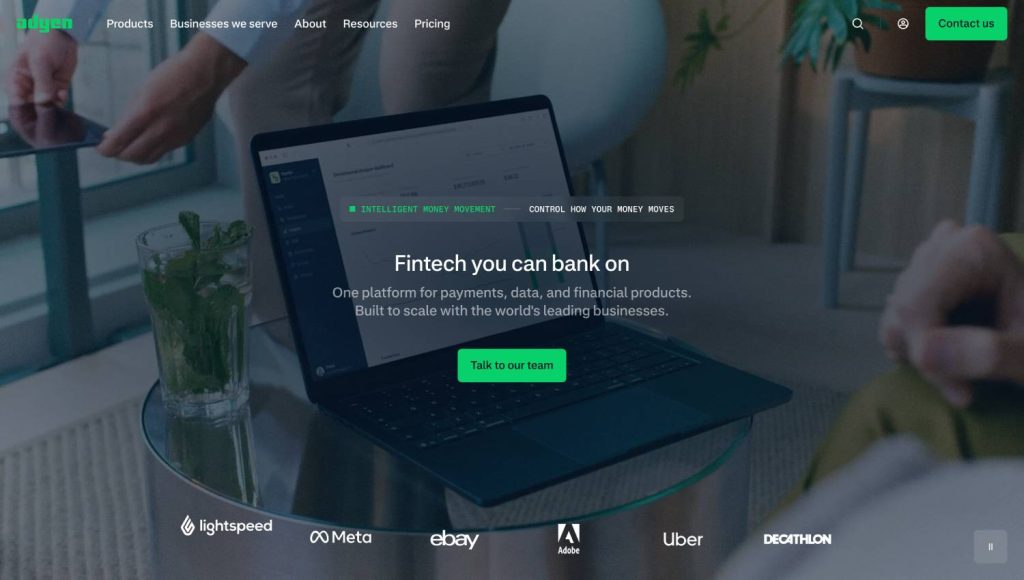
Adyen is the stronger choice for SaaS companies with global ambitions or high transaction volumes. Its unified commerce platform handles acquiring, issuing, and banking across more than 35 countries. Unlike Stripe, Adyen operates its own acquiring infrastructure in most markets, which gives it more control over approval rates and lower interchange costs at scale.
Adyen does not publish standard retail pricing publicly. It quotes based on volume and use case. This makes early-stage evaluation harder but is worth the conversation if you are processing significant volume or operating in multiple currencies.
Which Embedded Finance APIs Are Best for Card Issuing?
Marqeta
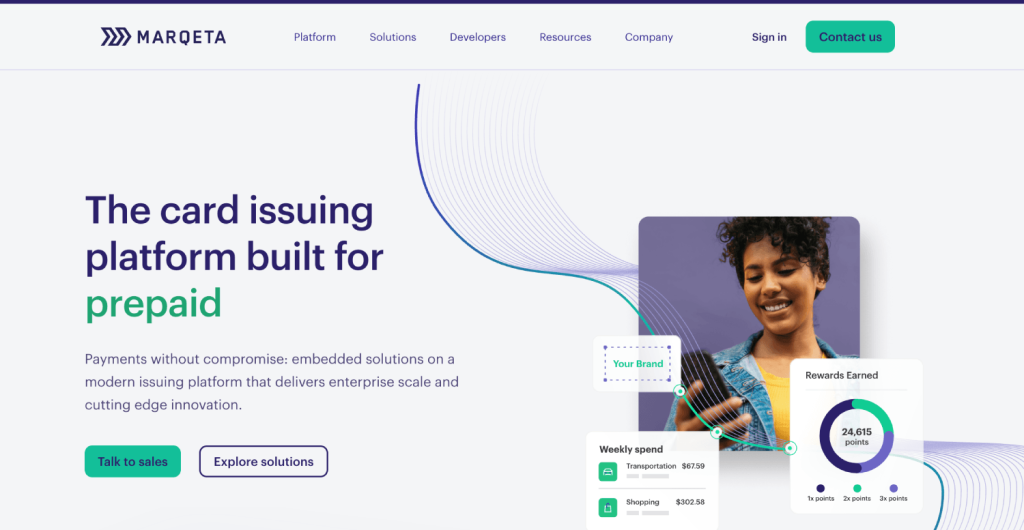
Marqeta is the most widely used card issuing infrastructure among fintechs and SaaS companies with programmatic card needs. Its open API architecture lets you control authorization logic at the transaction level, meaning you can set custom spend controls, velocity limits, and merchant category restrictions programmatically rather than through a static card program.
Marqeta is used by companies including Cash App, DoorDash, and Instacart for their card programs, which demonstrates its ability to operate at scale. It issues both Visa and Mastercard cards and handles both virtual and physical issuance. Pricing is not publicly listed and is negotiated based on program size and anticipated volume.
For SaaS companies building expense management, fleet cards, or corporate spend products, Marqeta gives more authorization-level control than Stripe Issuing. For simpler use cases like single-use virtual cards, Stripe Issuing is faster to implement.
Lithic
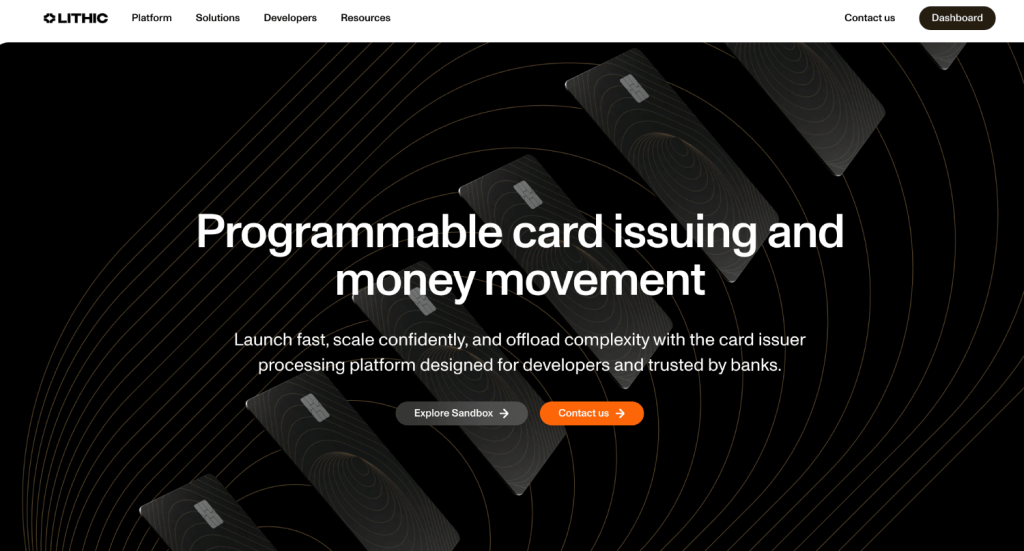
Lithic is worth evaluating alongside Marqeta, particularly for smaller programs or teams that want faster onboarding. Lithic provides virtual and physical card issuing via API, operates as a program manager, and publishes sandbox access without a sales call. For early-stage teams, that developer-first approach reduces time to first card issued significantly.
Stripe Issuing
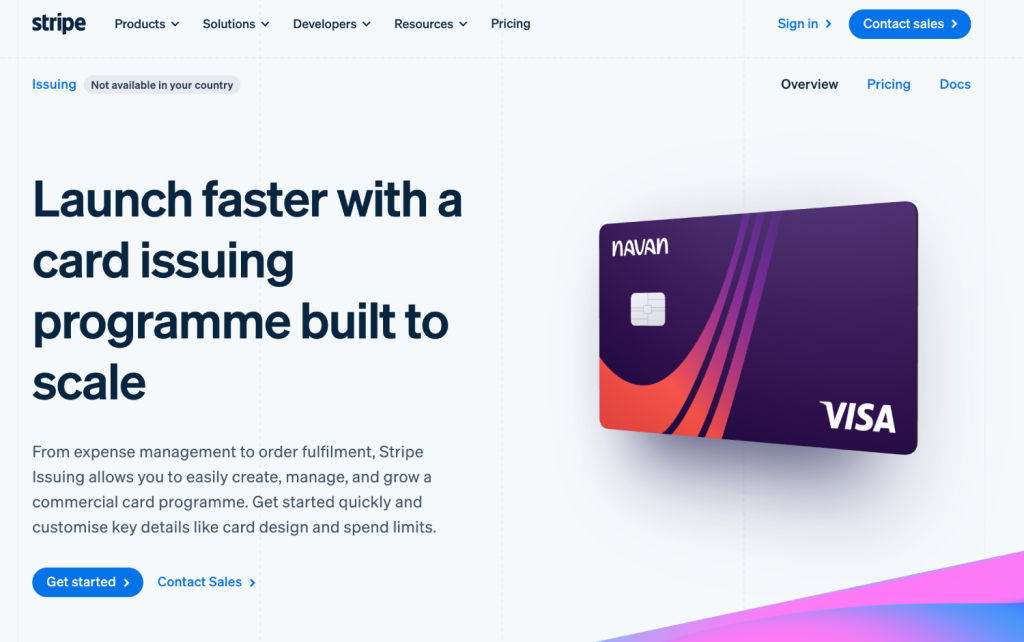
Stripe Issuing makes sense when you are already on Stripe for payments and want to add cards without introducing a second vendor. It supports Visa and Mastercard card networks, covers virtual and physical cards, spend controls, and real-time authorizations. The trade-off is less granular authorization logic than Marqeta and less flexibility for complex card programs.
Which Embedded Finance APIs Are Best for Banking and Accounts?
Unit
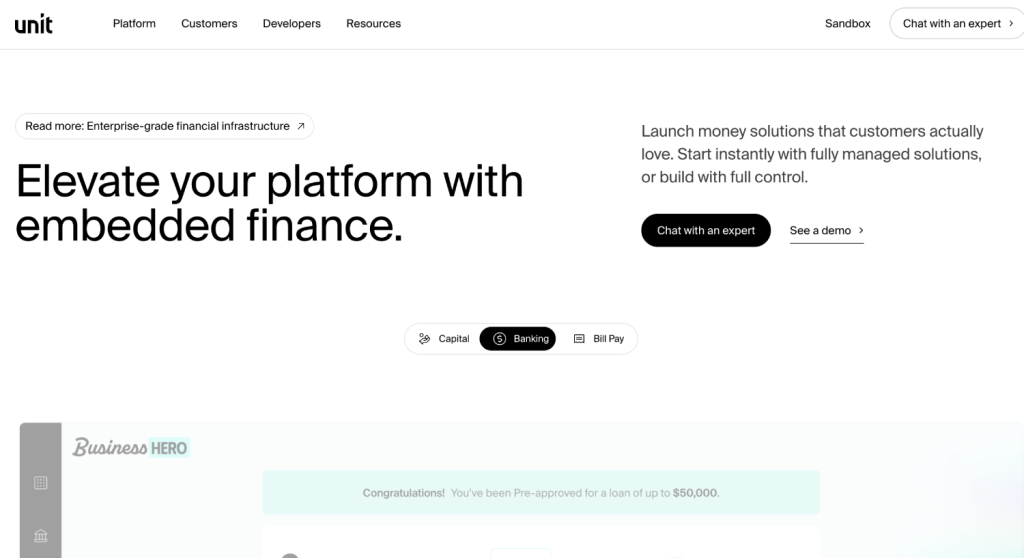
Unit is one of the strongest options for SaaS companies that want to offer FDIC-insured deposit accounts, debit cards, ACH, and wires under their own brand without holding a banking license. Unit acts as a program manager with partner bank relationships, abstracting the sponsor bank complexity. Its API covers account opening, KYC/KYB, balance management, and transaction history in a single integration.
Unit is particularly well positioned for vertical SaaS companies in industries like construction, trucking, and healthcare where holding funds on behalf of business customers creates retention and data advantages. Pricing is not publicly listed.
Synctera
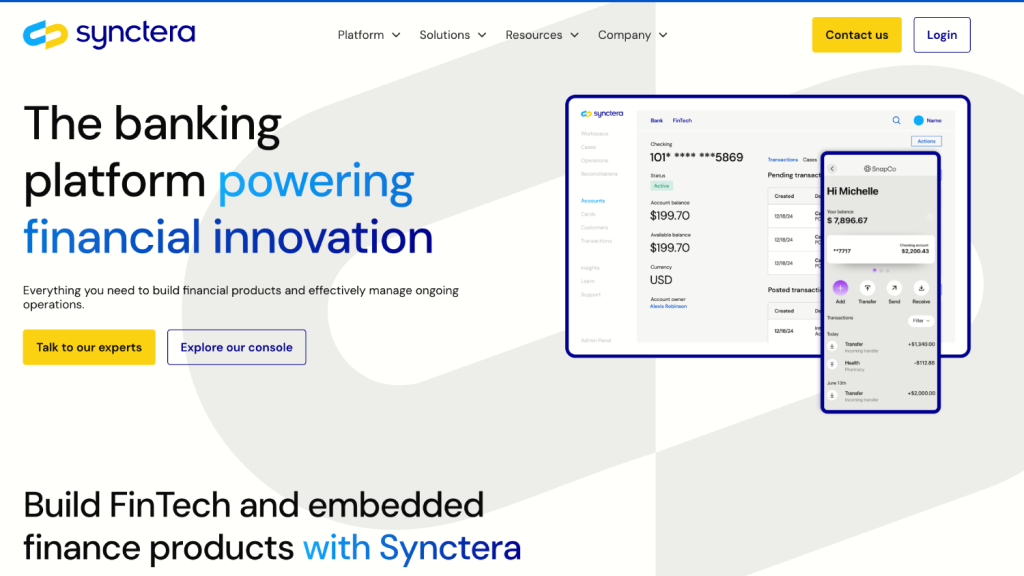
Synctera takes a slightly different approach, operating as a marketplace that matches fintech companies with partner banks and provides the middleware layer between them. This is useful if you want more visibility into and control over your sponsor bank relationship. It adds complexity compared to Unit but gives larger programs more optionality.
Treasury Prime
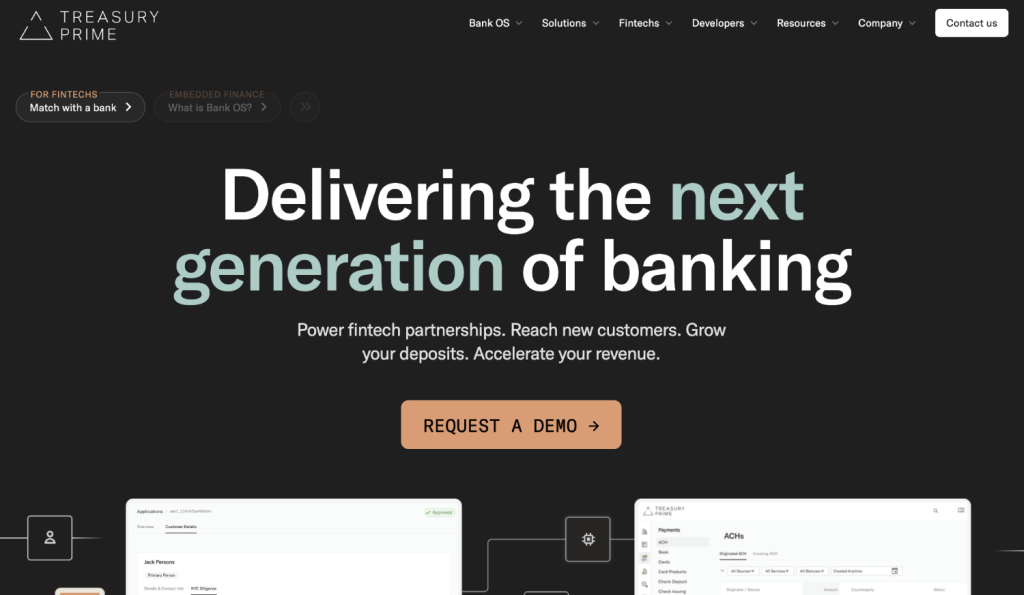
Treasury Prime operates similarly to Synctera, connecting SaaS and fintech companies to a network of community and regional banks. Its multi-bank architecture means you can route accounts to different banks based on geography or product type, which matters for programs that need specific bank capabilities.
Which Embedded Finance APIs Are Best for B2B Lending?
Kanmon
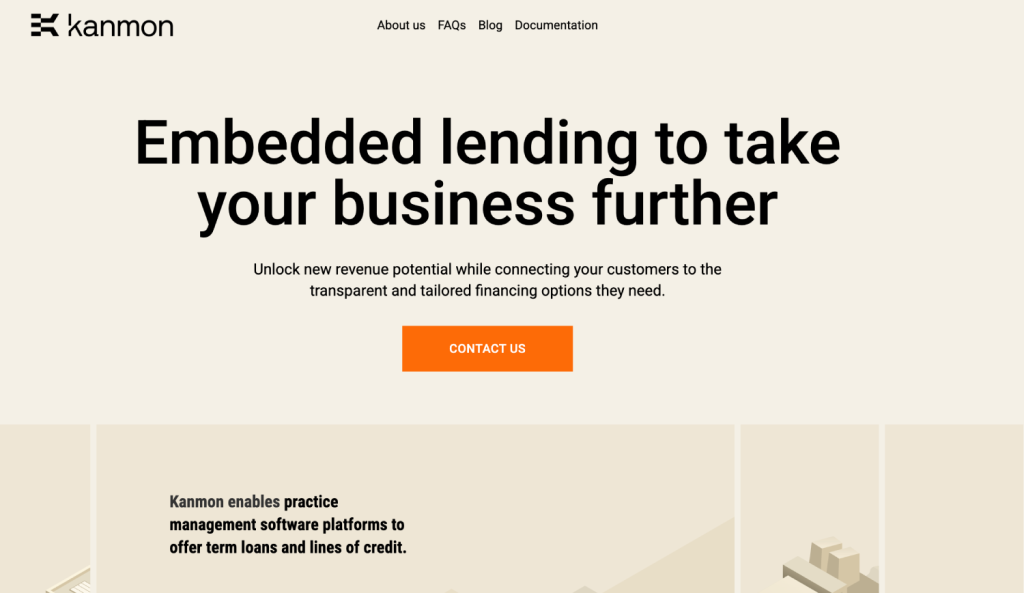
Kanmon is purpose-built for B2B embedded lending, targeting vertical SaaS companies that want to offer working capital, revenue-based financing, or invoice financing to their business customers. It handles underwriting, loan origination, servicing, and compliance, and it connects to existing SaaS data (invoices, payment history, revenue) to underwrite borrowers more accurately than a generic lender could.
For SaaS companies with strong longitudinal data on their customers’ business activity, embedded lending through Kanmon can become a high-margin revenue line. The underwriting advantage comes directly from the data moat the SaaS platform already has.
LoanPro
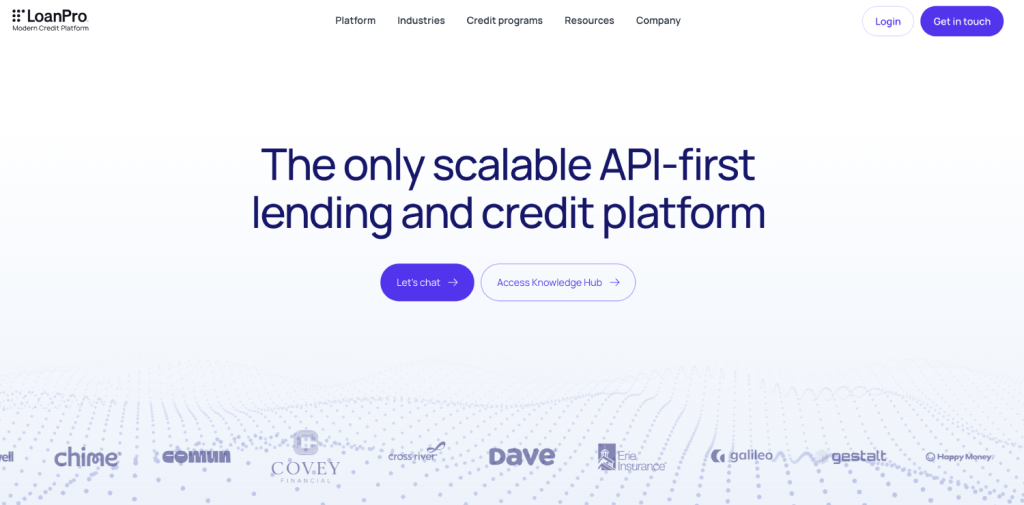
LoanPro is more of a loan management and servicing platform than a turnkey lending API, but it is relevant for SaaS companies building more customized lending products. It handles the loan lifecycle after origination, including payment processing, delinquency management, and borrower communications.
Which Embedded Finance APIs Are Best for Data and Connectivity?
Plaid
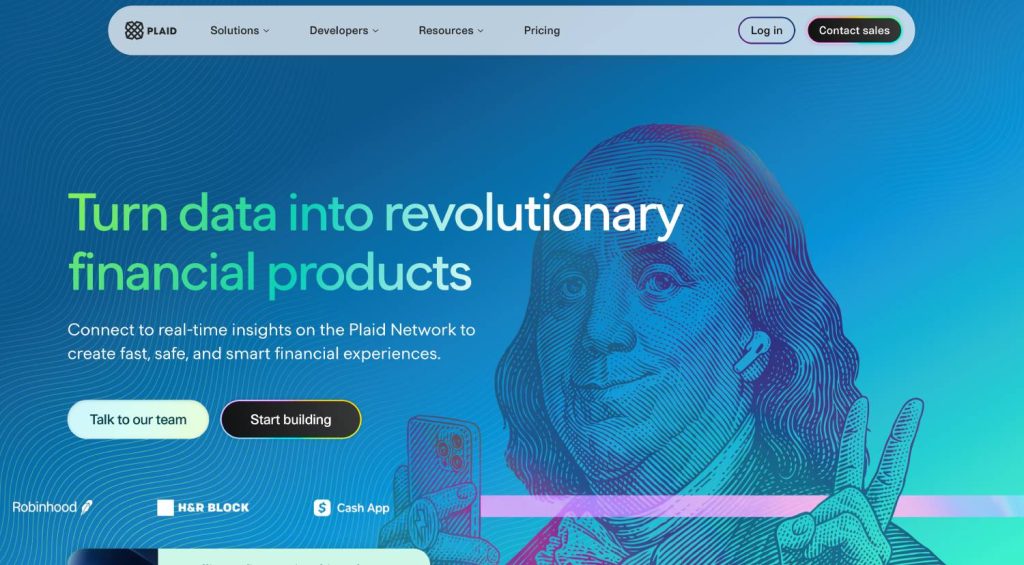
Plaid remains the dominant API for bank account connectivity in North America. Its Link product handles the consumer-facing authentication flow for connecting bank accounts, and its data products cover transaction history, account balances, income verification, and identity. According to Plaid’s public product documentation, it connects to more than 12,000 financial institutions in the US and Canada.
For SaaS companies building expense tracking, personal finance tools, or any product that needs to read user financial data, Plaid is the fastest path to coverage. Its pricing is usage-based and requires a developer account to review. The primary risk is that Plaid sits between your product and your users’ banks, which creates dependency on both Plaid’s uptime and its relationships with individual financial institutions.
MX and Finicity
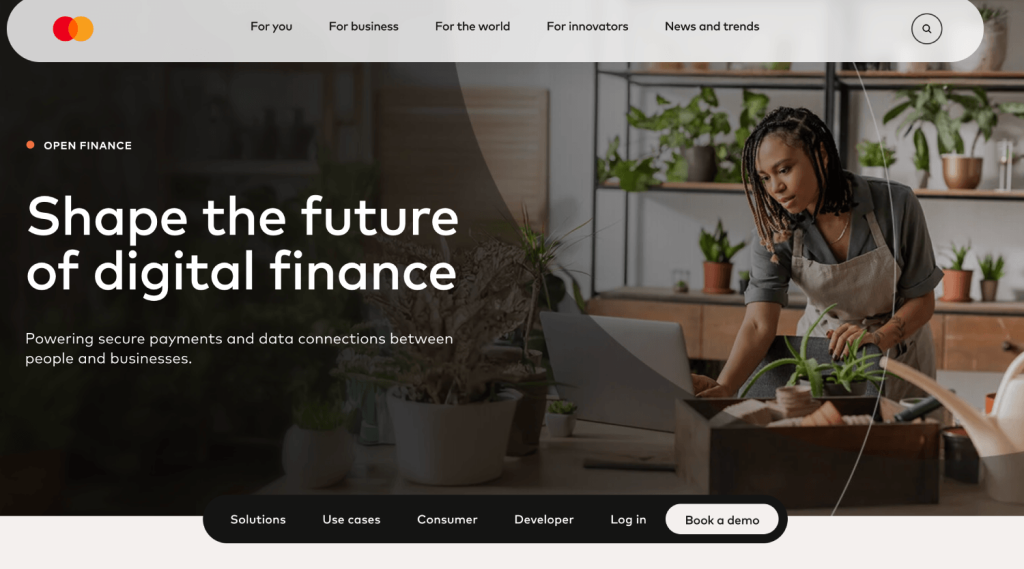
MX and Finicity (acquired by Mastercard in 2020) are the two strongest alternatives to Plaid. MX competes on data quality and enrichment, particularly for transaction categorization. Finicity is favored in mortgage and lending contexts where income and asset verification are required under specific regulatory frameworks. Neither replaces Plaid for consumer-facing bank connectivity breadth, but both are worth evaluating depending on your use case.
Which APIs Handle Compliance and Fraud Orchestration?
Compliance and fraud tooling is where most SaaS companies underinvest until something goes wrong. KYC and KYB checks, sanctions screening, fraud detection, and transaction monitoring are all imposed by your sponsor bank, your card network, or applicable law, depending on what financial products you embed.
Alloy
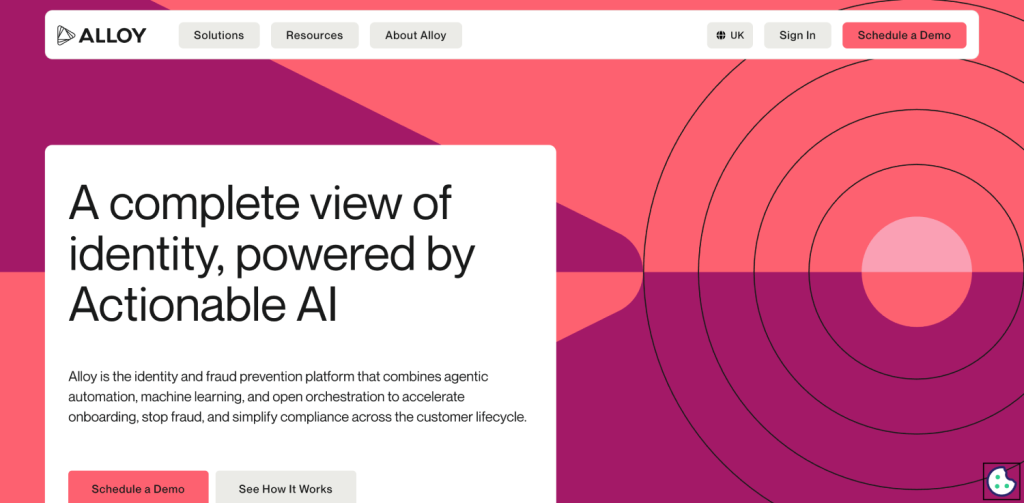
Alloy is an identity decisioning platform that connects to dozens of data sources including Plaid, credit bureaus, document verification providers, and watchlist databases. It lets you build automated onboarding workflows that handle KYC/KYB, risk scoring, and ongoing monitoring without writing custom logic for each data source. Most Banking-as-a-Service providers require or recommend an identity orchestration layer like Alloy.
Sardine
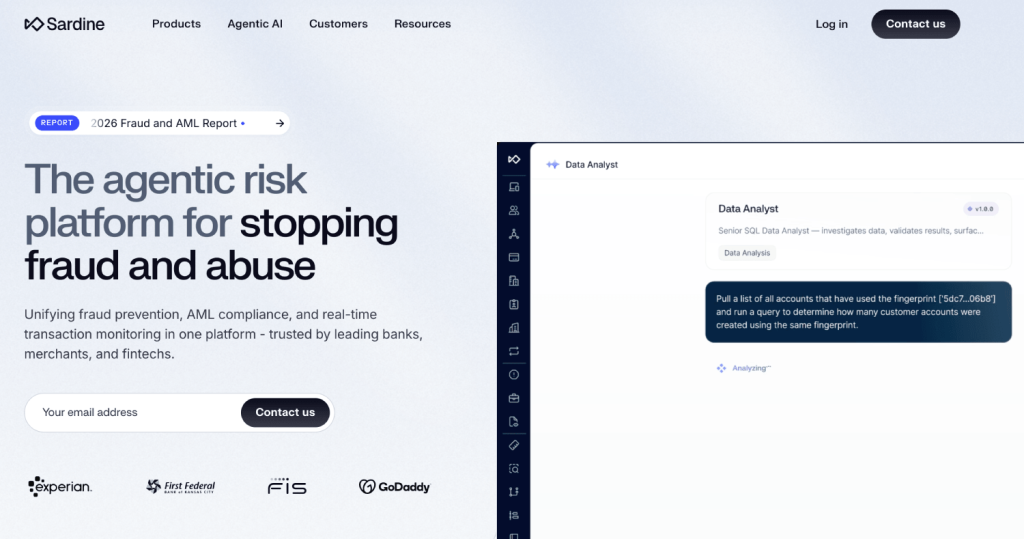
Sardine focuses on fraud detection and compliance for payments and onboarding. It uses device intelligence and behavioral signals alongside transactional data, which makes it particularly effective at catching account takeover fraud and synthetic identity fraud at the onboarding stage rather than after a transaction is processed.
Unit21
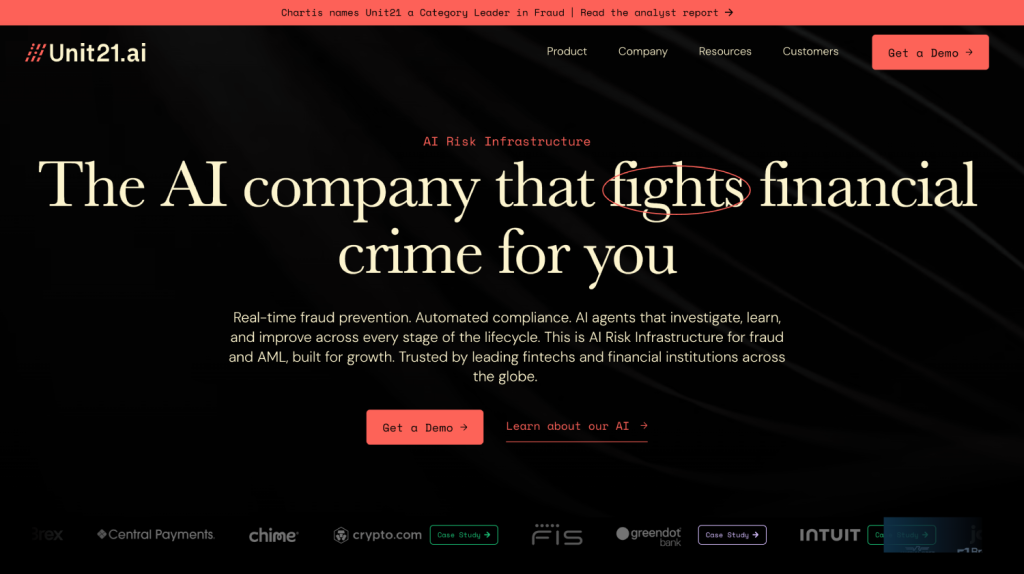
Unit21 handles transaction monitoring and case management, covering SAR filing, rules-based alerting, and analyst workflows. For SaaS companies that have crossed into regulated territory and need to demonstrate compliance to a sponsor bank or regulator, Unit21 provides the audit trail and workflow tooling that internal builds almost never get right. The best fraud detection and risk tools for fintech startups covers this category in more detail.
Embedded Finance API Comparison Table
| Provider | Category | Best For | Geography | Pricing Model |
|---|---|---|---|---|
| Stripe | Payments, Card Issuing, Banking | SaaS platforms, marketplaces, early-stage speed | Global (135+ countries) | Public per-transaction rates; custom at volume |
| Adyen | Payments, Acquiring, Issuing | High-volume SaaS, global expansion | Global (35+ countries direct acquiring) | Quote-based |
| Marqeta | Card Issuing | Custom card programs, spend controls | US, EU, Australia, Canada | Quote-based (volume-dependent) |
| Lithic | Card Issuing | Early-stage card programs, developer access | US | Usage-based; public sandbox available |
| Unit | Banking and Accounts | Vertical SaaS, business banking features | US | Quote-based |
| Synctera | Banking and Accounts | Programs needing direct sponsor bank access | US, Canada | Quote-based |
| Plaid | Data and Connectivity | Bank account linking, income verification | US, Canada, UK, EU | Usage-based; developer account required for rates |
| Kanmon | B2B Lending | Vertical SaaS with business customer data | US | Quote-based |
| Alloy | Compliance Orchestration | KYC/KYB automation, onboarding workflows | US, international | Quote-based |
| Sardine | Fraud Detection | Onboarding fraud, account takeover prevention | US, international | Quote-based |
| Unit21 | Transaction Monitoring | SAR filing, compliance workflows | US | Quote-based |
Which Embedded Finance Stack Should a SaaS Company Build by Use Case?
There is no universal stack. The right combination depends on your product, your customer, and how regulated your embedded product needs to be on day one.
Expense Management or Corporate Spend Tool
You need card issuing (Marqeta or Stripe Issuing), business accounts (Unit), and likely compliance orchestration (Alloy for KYB). Marqeta gives you the most control over authorization logic if you need custom spend policies. Stripe Issuing is faster if you are already on Stripe and your card program is relatively straightforward. Unit provides the account layer that holds the funds behind the cards.
Marketplace or Platform Payments
Stripe Connect handles the majority of multi-party payment use cases well through Series B. At higher volume, Adyen’s direct acquiring relationships produce better approval rates and lower effective costs. Add Plaid if you need ACH payouts or bank account verification on the disbursement side. Decisions about merchant of record structure matter here too, and the merchant of record comparison for B2B SaaS covers that trade-off separately.
Vertical SaaS with Business Banking Features
Unit is the clearest starting point for US-focused vertical SaaS wanting to offer checking accounts, debit cards, and ACH under their brand. Pair it with Alloy for KYB automation. If your customers are in industries with complex spend patterns, Marqeta’s authorization controls become relevant on the card side.
SaaS Platform Offering Working Capital or Financing
Kanmon is designed for exactly this. The underwriting model is built around SaaS platform data, which matters because your customers have a track record in your system that a bank or generic lender cannot see. The compliance burden for lending is heavier than for payments or cards, and selecting a partner that handles origination, servicing, and licensing on your behalf changes the implementation scope significantly.
What Are the Most Common Mistakes When Choosing an Embedded Finance API?
Choosing based on integration speed alone is the most expensive mistake. Fast sandbox access is a signal of good developer experience, not of regulatory coverage, sponsor bank stability, or pricing at scale. Teams that optimize for time-to-first-transaction often re-platform 18 months later when they hit a compliance gap or a pricing cliff.
The second common mistake is treating compliance as something to figure out after launch. Every Banking-as-a-Service provider has KYB and KYC requirements that your customers must pass before they can use the financial product. If you have not mapped those requirements to your user base, you will discover the friction at the worst possible moment: go-live. The section on critical mistakes when choosing fintech infrastructure covers this in more depth.
The third mistake is choosing a single vendor because they cover all six categories superficially, when a two-vendor stack with category specialists performs better across the board. Stripe covers payments, cards, and banking reasonably well. But if card issuing is your core product, Marqeta’s authorization controls, reporting, and card network relationships are materially better. The integration cost of a second vendor is real, but it is usually smaller than the product limitations you accept by using a generalist where a specialist exists.
Frequently Asked Questions
1. What is an embedded finance API?
An embedded finance API is an interface that lets a non-financial software company integrate financial products, such as payments, cards, bank accounts, or loans, directly into its own product without building those capabilities from scratch or obtaining its own financial licenses. The API provider (or its sponsor bank partner) holds the regulatory relationships while the SaaS company controls the user experience and product design.
2. Is embedded finance the same as Banking-as-a-Service?
Not exactly. Banking-as-a-Service (BaaS) refers specifically to platforms that let companies offer FDIC-insured banking features like accounts, ACH, and debit cards under their own brand through a sponsor bank relationship. Embedded finance is broader: it includes payments, card issuing, lending, insurance, and data connectivity, not just deposit banking. BaaS is one layer within the embedded finance stack, and the best Banking-as-a-Service platforms are covered separately on FintechSpecs.
3. How much does an embedded finance API typically cost?
Pricing varies significantly by category and volume. Stripe publishes transparent per-transaction rates (2.9% plus $0.30 for standard card processing, as listed on Stripe’s pricing page). Most BaaS providers, card issuing platforms, and lending APIs do not publish rates publicly and price based on program size, transaction volume, and product mix. Budget for both per-transaction fees and platform or monthly minimum fees, which can be substantial at early-stage volumes.
4. What compliance obligations come with embedding finance?
At minimum, KYC (Know Your Customer) or KYB (Know Your Business) verification is standard for virtually any embedded financial product. Card programs must adhere to Visa and Mastercard network rules. Deposit accounts require sponsor bank approval of your program. Lending products carry state licensing requirements in the US that vary by loan type and borrower location. Your embedded finance provider typically supplies the compliance framework, but your company remains responsible for implementing it correctly in your onboarding flows.
5. Which embedded finance API is easiest to integrate for an early-stage SaaS company?
Stripe is the fastest to integrate for payments and basic card issuing due to its developer documentation, public pricing, and sandbox environment. Lithic offers comparable ease for card issuing specifically. For bank accounts, Unit has strong documentation and a developer-friendly API structure. None of these providers should be selected on integration ease alone if your financial product is complex or your compliance requirements are significant.
6. Can a SaaS company use multiple embedded finance APIs?
Yes, and most mature embedded finance products do. A common stack might use Marqeta for card issuing, Unit for bank accounts, Plaid for bank connectivity, and Alloy for KYB orchestration. The integration overhead is real, but category specialists almost always outperform generalists in their core function. The more important consideration is whether your orchestration and data layer can unify the experience across vendors so your users see one coherent product.
7. What is the difference between a payments API and an embedded payments API?
A payments API processes transactions for your own business. An embedded payments API is designed to be white-labeled or extended into your product so your customers can accept payments themselves. Stripe Connect is a classic embedded payments API: it lets a marketplace platform give its merchants the ability to accept payments under the platform’s infrastructure. The distinction matters for regulatory reasons, because embedded payments often create money transmission obligations that standard payment acceptance does not.
8. How does embedded lending work for SaaS platforms?
Embedded lending lets a SaaS platform offer loans or financing to its business customers through an API-based lending partner. The platform typically provides customer data (revenue, transaction history, invoices) to improve underwriting accuracy. The lending partner handles origination, compliance, and servicing. The SaaS platform earns a referral fee or revenue share. Kanmon is the most purpose-built option for this model in the B2B SaaS context.
Choosing the Right Stack Is a Long-Term Bet
The vendors you integrate in year one will still be running under your product in year three. Migrating financial infrastructure mid-growth is painful in ways that migrating a CRM or analytics tool is not. Customer accounts, card programs, and compliance histories do not move cleanly between providers, and the user-facing disruption of a financial re-platform can damage the trust you built getting there.
The embedded finance category is mature enough now that the real differentiator between providers is not whether they have an API. It is the quality of their sponsor bank relationships, the depth of their compliance support, and how well their pricing model aligns with yours as you scale. Those three factors are harder to evaluate in a sandbox but are the ones that determine whether embedded finance improves your margins or erodes them. For a fuller view of how financial product decisions affect your unit economics as you grow, the Fintech SaaS Scale Checklist maps those dependencies across the growth curve.
Start with the financial product your users need most, find the specialist who is best at it, and build your compliance layer before your first user touches it. The vendors in this guide cover every category. The work is deciding which category to start in.