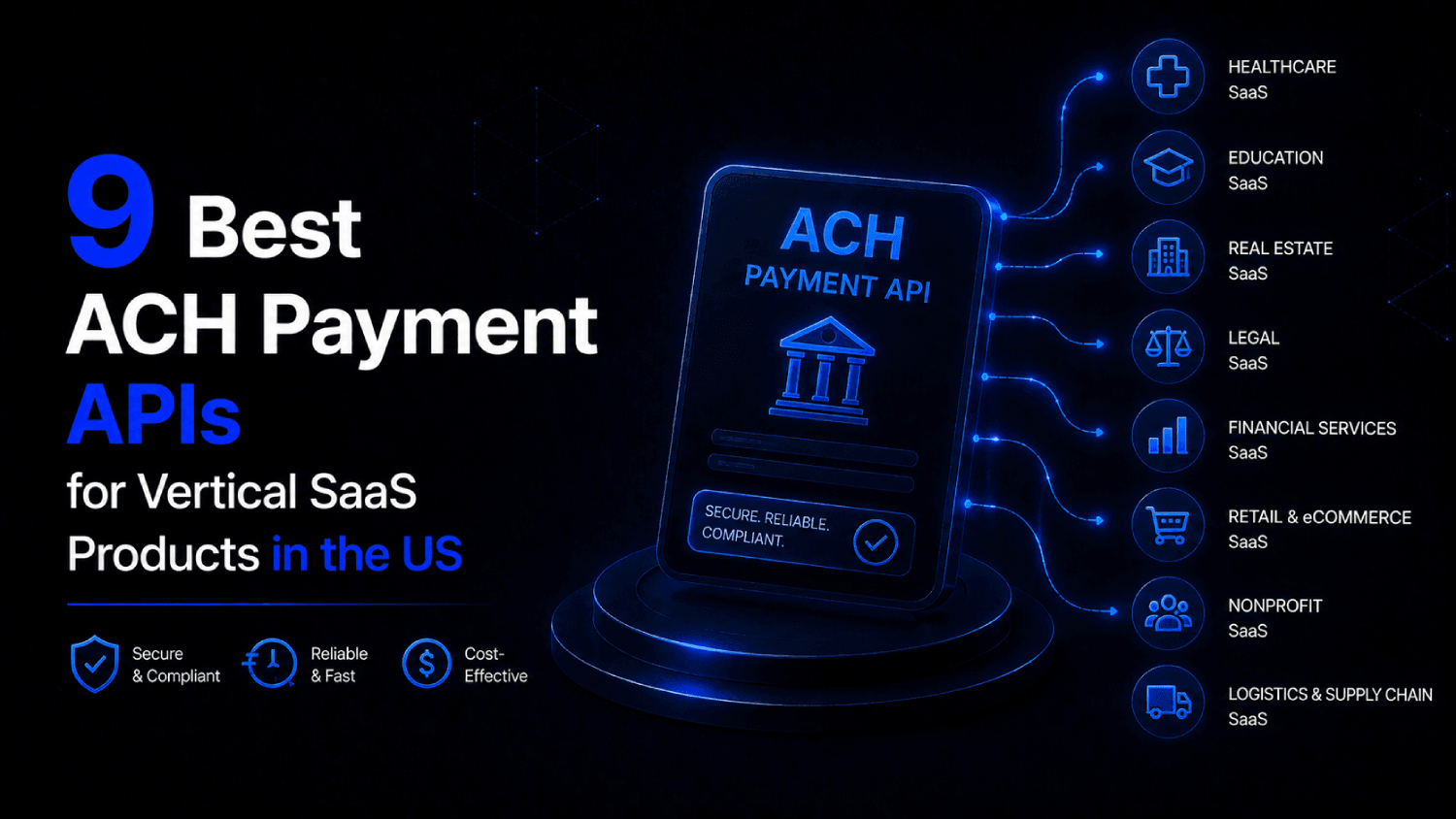

- ACH payment APIs for SaaS handle far more than the API call itself, return code routing, retry logic, and same-day settlement windows are where the operational complexity lives.
- ACH payments cost a fraction of card processing fees, which matters significantly when your SaaS handles high-ticket B2B transactions at volume.
- Stripe, Dwolla, and Plaid each approach ACH differently. Choosing the wrong one for your vertical adds operational debt you will feel at $5M ARR.
- Reconciliation and return rate monitoring are where most vertical SaaS products underinvest, and both are API-level decisions, not accounting decisions.
- For SaaS products processing high-ticket recurring payments, switching from cards to ACH on even 30% of volume can meaningfully change gross margin math.
The strongest ACH payment APIs for vertical SaaS products in the US are Stripe, Dwolla, Plaid, Moov, Nacha-direct processors like Modern Treasury, Finix, Checkbook, Helcim, and Column. Each solves a different part of the problem. Stripe is best for teams already on its stack who want ACH as a secondary method. Dwolla is built specifically for ACH-first products needing programmable bank transfer logic. Modern Treasury leads on reconciliation. Moov suits infrastructure-forward teams who want to own more of the stack. The right choice depends on your average transaction size, return risk tolerance, and whether your product disburses as well as collects.
Why ACH Beats Cards for High-Ticket Vertical SaaS Billing
Card processing at 2.9% plus $0.30 is a rounding error on a $49/month SMB subscription. On a $4,000/month property management platform fee or a $12,000 annual legal tech contract, it is $116 or $348 per transaction, respectively. That is not a payment cost. It is a margin problem.
ACH processing typically runs between $0.20 and $1.50 per transaction depending on the provider, with some charging a flat fee and others a small percentage capped at a low ceiling. The savings compound at volume. A vertical SaaS product billing 500 mid-market clients at $2,500/month pays roughly $36,000 in card fees monthly at 2.9%. Switching those customers to ACH at $0.75 per transaction costs $375. That delta goes straight to gross margin.
Cards also carry chargeback risk. ACH has return risk instead, which works differently and is in many ways more predictable. NACHA return rates have published thresholds. Stay below 0.5% for administrative returns and 3% for unauthorized returns and you avoid NACHA sanctions. That is a manageable target with the right tooling, not a liability. The actual state of FinTech SaaS gross margins makes this math worth running before you commit to any payment stack.
What Makes an ACH API Genuinely Good for SaaS (The FintechSpecs Return-and-Reconcile Test)
Most ACH API comparisons stop at pricing and developer experience. That misses where the operational debt accumulates. At FintechSpecs, we evaluate ACH payment APIs for SaaS products against what we call the Return-and-Reconcile Test, four specific capabilities that separate production-grade ACH infrastructure from a basic bank debit wrapper.
Return code handling: Does the API surface granular NACHA return codes (R01 through R33 and beyond) as structured data you can act on programmatically, or does it give you a generic “payment failed”? R01 is insufficient funds. R02 is account closed. R10 is unauthorized. Your retry logic, customer communication, and dunning flows depend on knowing which one fired.
Retry orchestration: Does the provider offer configurable retry windows, or do you have to build that logic yourself? Same-day ACH has different settlement windows than standard ACH. A good API exposes both and lets you choose per transaction.
Reconciliation hooks: Does every payment state change emit a webhook with enough metadata to auto-match against your internal ledger? Batch ACH files settled hours after initiation. If your API only tells you a batch settled without itemizing which transactions, your finance team is doing manual work.
Origination exposure: Is your product an originator, a third-party sender, or using a payment facilitator model? NACHA rules treat these differently. Your API provider’s compliance posture determines your exposure. If fintech compliance readiness is not already on your product roadmap, ACH origination will force the conversation.
The table below scores each provider against these four dimensions. The scoring reflects public documentation, published API references, and product pages, not vendor briefings.
Which ACH API Providers Are Worth Evaluating?
The market splits into three tiers: full-stack payment platforms that include ACH, ACH-native infrastructure providers, and bank-direct or ledger-first tools. The right tier depends on how much of the payment experience you want to own.
| Provider | ACH Pricing (public) | Same-Day ACH | Return Code Detail | Reconciliation API | Best For |
|---|---|---|---|---|---|
| Stripe | 0.8%, max $5 | Yes (premium) | Structured | Good via Events | Teams already on Stripe |
| Dwolla | Custom (starts ~$250/mo platform fee) | Yes | Detailed | Strong | ACH-first SaaS products |
| Modern Treasury | Custom enterprise pricing | Yes | Very detailed | Strongest reconciliation layer in the category | Finance ops-heavy platforms |
| Moov | Usage-based, published on site | Yes | Structured | Strong | Infrastructure-owning teams |
| Finix | Custom | Yes | Structured | Strong | Vertical SaaS becoming PayFac |
| Plaid Transfer | Custom | Yes | Structured | Moderate | Teams using Plaid for bank auth |
| Helcim | Interchange-plus model, ACH flat fee | Limited | Basic | Moderate | SMB-focused SaaS |
| Checkbook | Starts at $0.25/ACH | Yes | Moderate | Moderate | Disbursement-heavy workflows |
| Column | Custom (bank-direct; you integrate with the chartered bank itself, not an intermediary originator) | Yes | Very detailed | Strong | Teams building on bank infrastructure |
Pricing on all of these reflects public information as of their respective pricing or product pages. Custom pricing means the company does not publish a rate card but negotiates based on volume.
The Return-and-Reconcile Test Applied: Three Worked Examples
The four criteria above are most useful when applied concretely. Here is how three providers score against each dimension in a realistic vertical SaaS context, a property management platform billing landlords on a recurring monthly schedule with occasional disbursements to contractors.
Stripe: Return code handling scores well. Stripe surfaces R01, R02, R10, and the rest as structured webhook events under the payment_intent.payment_failed and charge.updated event types, giving you enough data to route dunning logic programmatically. Retry orchestration is where Stripe shows its card-first origins, configurable retry windows for ACH require custom logic on your end rather than a built-in retry engine. Reconciliation hooks are solid via the Events API, but auto-matching to an internal ledger means writing your own matching layer. Origination exposure is low-friction: Stripe handles NACHA compliance as the third-party sender, which reduces your direct exposure but also limits originator-level controls. Verdict on the Return-and-Reconcile Test: passes three of four dimensions cleanly; retry orchestration requires custom engineering.
Modern Treasury: Return code handling is the most detailed in the category, every return maps to a structured payment object with code, reason, and timestamp, and the API supports filtering by return code type to separate unauthorized returns from administrative ones before they age into a NACHA threshold problem. Retry orchestration is configurable through payment order rules. Reconciliation hooks are the core product: Modern Treasury’s reconciliation engine auto-matches transactions to expected flows using rules you define, which is what makes it the right answer for any team where month-end close currently involves spreadsheets. Origination exposure is explicit in the product, it supports both originator and third-party sender models with documentation for each. Verdict: passes all four dimensions; the trade-off is enterprise pricing and integration complexity that is not justified for moderate ACH volumes.
Dwolla: Return code handling exposes full NACHA granularity as webhook events. Retry orchestration has a programmable retry engine, which is the clearest differentiator from Stripe in this dimension, you configure retry cadence, timing, and conditions through the API. Reconciliation hooks require proper webhook configuration but deliver strong coverage when set up correctly. Origination exposure is handled through Dwolla’s ODFI relationships; you operate as a sender under Dwolla’s umbrella, which covers most vertical SaaS use cases without requiring your own ODFI agreement. Verdict: passes all four dimensions; better than Stripe on retry orchestration, but requires a more deliberate initial integration.
Provider-by-Provider Analysis: What You Actually Need to Know
Stripe ACH Direct Debit
Stripe’s ACH Direct Debit charges 0.8% per transaction capped at $5.00, which means transactions over $625 pay the flat cap. For high-ticket SaaS, that is effectively $5 per payment regardless of size. Same-day ACH is available at an additional fee, and Stripe’s webhook infrastructure handles return codes as structured events you can route programmatically. The developer experience is polished. The downside is that Stripe is not ACH-native. Its mental model is card-first, and the ACH product works well but lacks some of the originator-level controls that ACH-native providers expose. Teams already embedded in Stripe’s billing, radar, and revenue recognition tooling should stay on Stripe for ACH. Teams where ACH is the primary collection method, not a fallback, should look elsewhere.
Dwolla
Dwolla is purpose-built for ACH-first workflows. Its API exposes full NACHA return code detail, supports same-day ACH, and includes a programmable retry engine. Pricing is platform-fee based rather than purely per-transaction, which favors high-volume senders. Dwolla also supports send-and-receive in the same integration, making it useful for marketplaces or platforms that both collect from and pay out to end users. The trade-off is that Dwolla requires a more deliberate integration than Stripe. You are building a payment system, not dropping in a payment method. That is a feature for the right team, but it adds scope for teams that just want bank debit to work with minimal overhead.
Modern Treasury
Modern Treasury approaches ACH from the reconciliation layer outward. Every payment object carries a full audit trail. Return codes map to structured data. The reconciliation API auto-matches payments against expected flows using configurable rules. For SaaS products where the finance team processes significant monthly volume and reconciliation is a time sink, Modern Treasury cuts that overhead materially. The product also supports wire, RTP, and international payments in the same API, which matters as platforms scale. Pricing is enterprise and requires a conversation, but the product earns consideration for any team where ACH is genuinely central to their business model and their current reconciliation process involves spreadsheets.
Moov
Moov is worth evaluating if your team wants to own more of the payment infrastructure rather than rent it. Moov publishes usage-based pricing on its site, which is rare in this space and useful for modeling costs before signing a contract. The API is designed for teams comfortable operating at the infrastructure layer. Moov supports ACH, same-day ACH, cards, and RTP in a single ledger model. Return handling is structured. The developer documentation is thorough. This is not the right pick for a small team that wants payments to just work. It suits a team with dedicated fintech engineering capacity that wants to build payment features without navigating the full regulatory overhead of becoming a licensed money transmitter. Moov holds the licenses. You build on top.
Finix
Finix targets vertical SaaS companies that want to move toward becoming a payment facilitator without acquiring all the infrastructure themselves. ACH is one component of its broader embedded payments stack. The return handling and reconciliation capabilities are solid. Where Finix differentiates is in its ability to help a vertical SaaS company split fees, manage sub-merchant onboarding, and run an embedded payments program at scale. If your roadmap includes monetizing payments as a revenue line and not just reducing fees, Finix is worth evaluating. Teams that just want cheap ACH collection probably do not need everything Finix provides. The broader context of payment infrastructure decisions for SaaS founders is relevant here.
Plaid Transfer
Plaid Transfer pairs well with Plaid’s bank account verification products. If you are already using Plaid Auth to verify bank accounts before initiating ACH debits, adding Plaid Transfer keeps the stack consolidated. Plaid’s ACH product includes same-day ACH, return code handling, and risk scoring built into each transfer. The risk scoring is genuinely useful: Plaid signals return risk before you initiate, drawing on account signal data from its bank connectivity network. This matters for reducing R01 and R09 returns on new customers. The trade-off is that Plaid’s pricing is custom and its ACH product is less feature-rich for outbound disbursements than Dwolla or Moov. It is a strong choice for collection-heavy flows where bank verification and risk scoring reduce return rates. The broader comparison of bank connectivity options including Plaid, MX, and Finicity is worth reading if bank data access is part of your architecture.
Helcim
Helcim competes on price transparency. Its interchange-plus card model extends to ACH with flat fees visible on its public pricing page. The developer API is functional. Return handling is adequate. Where Helcim lags against ACH-native providers is in same-day ACH support and reconciliation sophistication. It is a reasonable option for smaller SaaS products where card and ACH volume are roughly comparable and the team wants a single, cost-transparent payment processor without a custom pricing negotiation. High-volume or high-ticket verticals will likely outgrow it.
Checkbook
Checkbook is built around disbursements, specifically replacing paper check workflows with digital ACH and virtual card payouts. For SaaS products with disbursement-heavy use cases, such as insurance claims platforms, contractor payment tools, or property management software paying out to landlords, Checkbook’s per-ACH pricing starting at $0.25 is attractive. Its ACH collection features exist but are secondary to its payout product. Evaluate Checkbook if paying out to end users is your primary use case and collection from customers is handled elsewhere.
Column
Column is a nationally chartered bank that exposes developer APIs directly against its own core banking infrastructure. This is technically distinct from every other provider in this list: rather than routing through a bank partner as a third-party sender or payment facilitator, you are originating ACH entries through the bank itself. That means Column can expose settlement timing, return file data, and origination controls at the bank-ledger level, not filtered through an intermediary’s abstraction layer. The compliance posture shifts accordingly: some obligations that a third-party sender absorbs on your behalf instead become part of your direct agreement with Column. For teams building embedded finance products or fintech infrastructure that requires bank-level access without becoming a bank, Column is a serious option. It is not a drop-in payment API for a startup that wants ACH collection in two weeks. This connects to the broader architecture question of what banking-as-a-service platforms actually provide versus what bank-direct access gives you.
How Do NACHA Return Codes Affect Your SaaS Operations?
NACHA return codes determine what your dunning logic, customer communication, and retry strategy look like. Getting a batch return without granular codes forces a manual triage process. Getting structured codes lets you automate most of it.
The most common returns in SaaS billing contexts are R01 (insufficient funds), R02 (account closed), R03 (no account), R04 (invalid account number), R10 (customer advises not authorized), and R29 (corporate customer advises not authorized). R01 is retriable after sufficient time. R02, R03, and R04 require updated banking information from the customer. R10 and R29 are unauthorized returns and count toward your NACHA return rate cap, which means they require a different operational response entirely.
NACHA’s published return rate thresholds are 0.5% for administrative returns (like R02 and R03) and 3% for unauthorized returns (R10, R29). Exceed those thresholds and your ODFI (originating depository financial institution) can terminate your ACH origination privileges. That is an operational catastrophe for any platform where ACH is a primary payment method. Your ACH API needs to surface unauthorized returns separately, in real time, so your risk team can investigate before you hit a pattern that triggers scrutiny. Poor return rate management is one of the hidden costs that erode SaaS margins over time.
Does Same-Day ACH Matter for Vertical SaaS Products?
Same-day ACH settles within the same business day if initiated before NACHA’s cutoff windows (10:30 AM ET and 2:45 PM ET for the two same-day windows). Standard ACH takes one to two business days. For subscription billing, standard ACH is usually sufficient. The customer does not care whether funds clear today or tomorrow when paying a recurring software fee.
Same-day ACH matters in three specific SaaS contexts. First, revenue-cycle management software where a healthcare provider needs to confirm a payment cleared before releasing a service. Second, gig economy platforms where contractors expect same-day payouts. Third, any SaaS product where the downstream action (account activation, goods released, booking confirmed) is gated on payment settlement. If your product has a time-sensitive fulfillment event tied to payment, build same-day ACH support into your architecture from the start. Adding it later means re-engineering retry and settlement logic.
What Does an ACH Integration Actually Cost at Scale?
Consider a vertical SaaS company serving commercial real estate. It processes 800 monthly invoices averaging $3,200 each, for $2.56M in monthly collections. On cards at 2.9% plus $0.30, that is approximately $74,480 per month in payment fees. On ACH at $0.80 per transaction (Stripe’s effective rate at the $5 cap), that is $4,000. On a flat $0.75 ACH fee, it is $600.
The annual spread between cards and ACH at that volume is roughly $845,000 to $893,000. This scenario assumes full ACH adoption and a clean payment success rate. In practice, partial ACH adoption and return-related retries will compress the realized savings, a 60% ACH adoption rate at $0.75 per transaction still saves over $500,000 annually, but actual return rates of 1 to 3% on new customer cohorts add operational cost (labor or automation tooling) that should be modeled against the gross savings. Even with those offsets, the math almost always favors ACH for high-ticket B2B collections once volume justifies the integration investment. At a Series A or B company where gross margin pressure is real, that delta is not an accounting footnote. It is a fundraising story.
The offsetting costs to model are: return handling (if R01 rates run at 1-2%, add operational labor or automation tooling costs), same-day ACH premiums (typically $0.50 to $1.00 additional per transaction where required), and the API platform fee for ACH-native providers like Dwolla that charge a monthly minimum.
How Should Vertical SaaS Products Handle ACH Reconciliation?
ACH payments do not settle transaction by transaction in real time. They settle in batches, and those batches arrive hours after initiation. If your integration just logs “ACH payment initiated” and waits for a webhook, you are one settlement delay away from a discrepancy that takes an hour to untangle.
Good ACH reconciliation architecture assigns a unique origination trace number to every transaction, stores expected settlement dates against each, and runs an automated match when the settled batch arrives. When a batch return file comes back with returns inside it, the system should auto-identify which internal payment objects correspond to the returned items and update their status before a human sees the discrepancy report.
Modern Treasury is the strongest off-the-shelf solution for this. Moov and Dwolla both handle it well with proper webhook configuration. Stripe’s Events API can power a solid reconciliation flow, but you have to build more of the matching logic yourself. If your product will process more than a few hundred ACH transactions per month, budget engineering time for reconciliation infrastructure before you ship the payment feature. Companies that skip this step often discover the problem at month-end close when the finance team needs three hours to reconcile a batch that should have auto-matched.
Frequently Asked Questions
What is an ACH payment processing API?
An ACH payment processing API is a programmatic interface that lets software products initiate, receive, and manage bank-to-bank transfers over the ACH network. For SaaS companies, it handles debiting customer bank accounts for subscription fees or invoices, crediting vendors or contractors, and receiving structured data about each transaction’s status, including settlement confirmation and return codes when a payment fails.
Can you automate ACH payments for recurring SaaS billing?
Yes. ACH APIs support scheduled and recurring debits triggered programmatically. You store a bank account token (authorized once during customer onboarding), set a billing schedule, and the API initiates each debit without manual intervention. Most providers like Stripe, Dwolla, and Plaid Transfer support mandate storage so you are not re-authorizing the customer each cycle. Automated retry logic on returns like R01 is also configurable through the API.
How is ACH different from card payments for SaaS billing?
Cards settle in real time but carry chargeback risk and high percentage-based fees. ACH settles in one to two business days (same-day for premium tiers), costs far less per transaction, and carries return risk governed by NACHA return rate thresholds rather than card network chargeback rules. Cards have higher consumer adoption. ACH is almost always cheaper for high-ticket B2B transactions where the customer is a business with a checking account and the invoice amount makes card fees material.
What NACHA return rate limits should SaaS companies know?
NACHA sets two key return rate thresholds. Administrative returns (R02, R03, R04 for account issues) must stay below 0.5%. Unauthorized returns (R10, R29, where a customer disputes the authorization) must stay below 3%. Exceeding these rates triggers scrutiny from your originating bank and can lead to loss of ACH origination privileges. Monitoring these rates in real time through your API’s return code data is not optional at production volume.
Does ACH work for same-day payments in SaaS products?
Same-day ACH is available through most major providers including Stripe, Dwolla, Moov, Modern Treasury, and Column. Transactions must be submitted before NACHA’s cutoff windows (10:30 AM ET and 2:45 PM ET) on banking days. Same-day ACH typically costs more per transaction than standard ACH. It is worth the premium when payment settlement needs to trigger an immediate downstream action in your product, but standard ACH is adequate for most subscription billing use cases.
Is ACH cheaper than card processing for SaaS?
For high-ticket transactions, ACH is substantially cheaper than card processing. Stripe charges 0.8% capped at $5.00 for ACH versus 2.9% plus $0.30 for standard card transactions, with no cap. On a $2,000 invoice, the card fee is $58.30 and the ACH fee is $5.00. The difference widens with transaction size. For SaaS products billing under $100 per transaction, card convenience and real-time settlement may outweigh the fee savings. Above $300 per transaction, ACH almost always wins on cost.
How do you choose the right ACH API for a vertical SaaS product?
Start with transaction size and volume, then evaluate return rate risk given your customer profile, then assess whether you need outbound disbursements in addition to inbound collection. If you are already on Stripe, stay on Stripe unless ACH is your primary payment method. If ACH is central to your product economics and you process at volume, evaluate Dwolla or Modern Treasury. If you want bank-direct infrastructure control, look at Column or Moov. Match the provider to your integration complexity tolerance, not just the fee structure.
What is ACH origination and does it affect compliance requirements?
ACH origination means your product is the party submitting debit or credit entries to the ACH network through an originating depository financial institution. As an originator or third-party sender, you are bound by NACHA operating rules, including return rate limits, authorization requirements, and audit obligations. Most ACH API providers act as third-party senders on your behalf, which reduces direct NACHA compliance exposure but does not eliminate it. Understanding whether your ACH API makes you an originator or a downstream sender matters for your compliance posture and your contract terms with the provider.
The Selection Decision in Practice
Most vertical SaaS founders evaluating ACH payment APIs default to whichever provider they have already used for card processing, usually Stripe. That is a defensible starting point but not always the right answer. Stripe’s ACH product is capable and well-documented. For teams processing moderate ACH volume alongside cards, it handles the job without introducing a new vendor relationship. The ceiling on Stripe’s ACH product becomes visible when you need deep origination controls, complex retry logic across multiple customer segments, or reconciliation automation that matches to an internal ledger with custom rules. That is when ACH-native providers earn their platform fees.
The embedded payments question matters here too. Vertical SaaS products at Series A and beyond often face a choice between accepting payments and enabling payments as a feature. Finix and Moov sit at that architectural boundary. If your product roadmap includes revenue sharing on payments, sub-merchant management, or launching payments as a billable feature for your customers, the ACH API decision is also a platform architecture decision. That choice deserves more analysis than a fee comparison. The broader framework for evaluating fintech APIs for SaaS products applies here.
ACH is not an operational detail. For any SaaS product billing B2B customers above $500 per transaction, the payment method is a margin decision. Getting the API right means getting return handling, reconciliation, and origination compliance right from the start, not retrofitting them after a NACHA inquiry or a finance team revolt during month-end close.