
TLDR
- Most cash application teams auto-match fewer than 70% of payments without software, leaving clerks to manually reconcile the rest against aging reports.
- The tools below push auto-match rates to 85-95%+ by reading remittance from email, portal, EDI, and PDF sources simultaneously.
- Match rate is the single most important evaluation metric, but ERP connectivity and exception workflow design determine whether that rate holds at scale.
- HighRadius and Billtrust target enterprise AR teams; Versapay and Kolleno fit mid-market and Series B-C SaaS companies; Cforia and Esker serve manufacturers and distributors with complex deduction workflows.
- None of these tools publish standard per-invoice pricing openly. Every vendor requires a discovery call, but pricing signals and contract structures are summarized below.
Cash application software auto-matches incoming B2B payments to open invoices using AI trained on remittance data from email, EDI, lockbox, and customer portals. The best platforms reach auto-match rates of 85-95%, reduce days sales outstanding, and route only true exceptions to human review. The nine tools below are the primary options evaluated by AR and FinOps teams at mid-market and enterprise companies in North America.
Why Is Cash Application Still Manual at Most Companies?
The average B2B payment arrives with remittance data in three to five different formats across a given customer base. One buyer emails a PDF remittance. Another sends 820 EDI files. A third pays through a self-service portal and attaches nothing. Your ERP sees a wire for $47,382 and has no idea which of the 23 open invoices it covers.
That gap between payment receipt and invoice matching is where AR clerks spend hours every day. The manual process is not just slow. It introduces posting errors, delays cash visibility, and makes month-end close a scramble. The core belief that this is just “how AR works” is the main reason companies wait too long to automate it.
Modern cash application automation tools ingest remittance from every source simultaneously, apply machine learning trained on your specific customer payment patterns, and match payments to invoices with confidence scores. Anything below a confidence threshold goes to an exception queue, not back to a spreadsheet. For finance teams thinking about the broader AR automation stack, cash application is typically the highest-ROI starting point because the labor savings are immediate and measurable.
What Is the FintechSpecs Cash Application Evaluation Framework?
Comparing cash application platforms on feature lists alone produces the wrong answer. Vendors all claim high match rates. The question is: under what conditions, with which data sources, and at what exception volume?
The FintechSpecs MERIT Framework structures the evaluation across five dimensions that actually differentiate platforms in practice:
- Match Rate Ceiling: The published or customer-reported auto-match rate under real-world conditions, not a lab demo with clean EDI data. Ask for match rate across all payment types, including checks with no remittance.
- Exception Workflow: How exceptions are presented, prioritized, and routed. A platform with an 85% match rate and a clean exception UX beats a 90% match rate platform where exceptions pile into a flat queue.
- Remittance Ingestion Breadth: Whether the platform can read email body text, PDF attachments, portal scraping, EDI 820, lockbox image files, and ACH addenda simultaneously without manual formatting.
- Integration Depth: Native connectors to your ERP (SAP, Oracle, NetSuite, Dynamics) versus generic API, and whether the integration is real-time or batch.
- Training Velocity: How quickly the ML model learns your customer base. Some platforms need 90 days of historical data to hit advertised match rates. Others accelerate with pre-built customer payment behavior models.
Run every vendor through MERIT in sequence. A weak answer on remittance ingestion breadth almost always predicts a disappointing live match rate.
Which Cash Application Software Platforms Should You Evaluate?
1. HighRadius
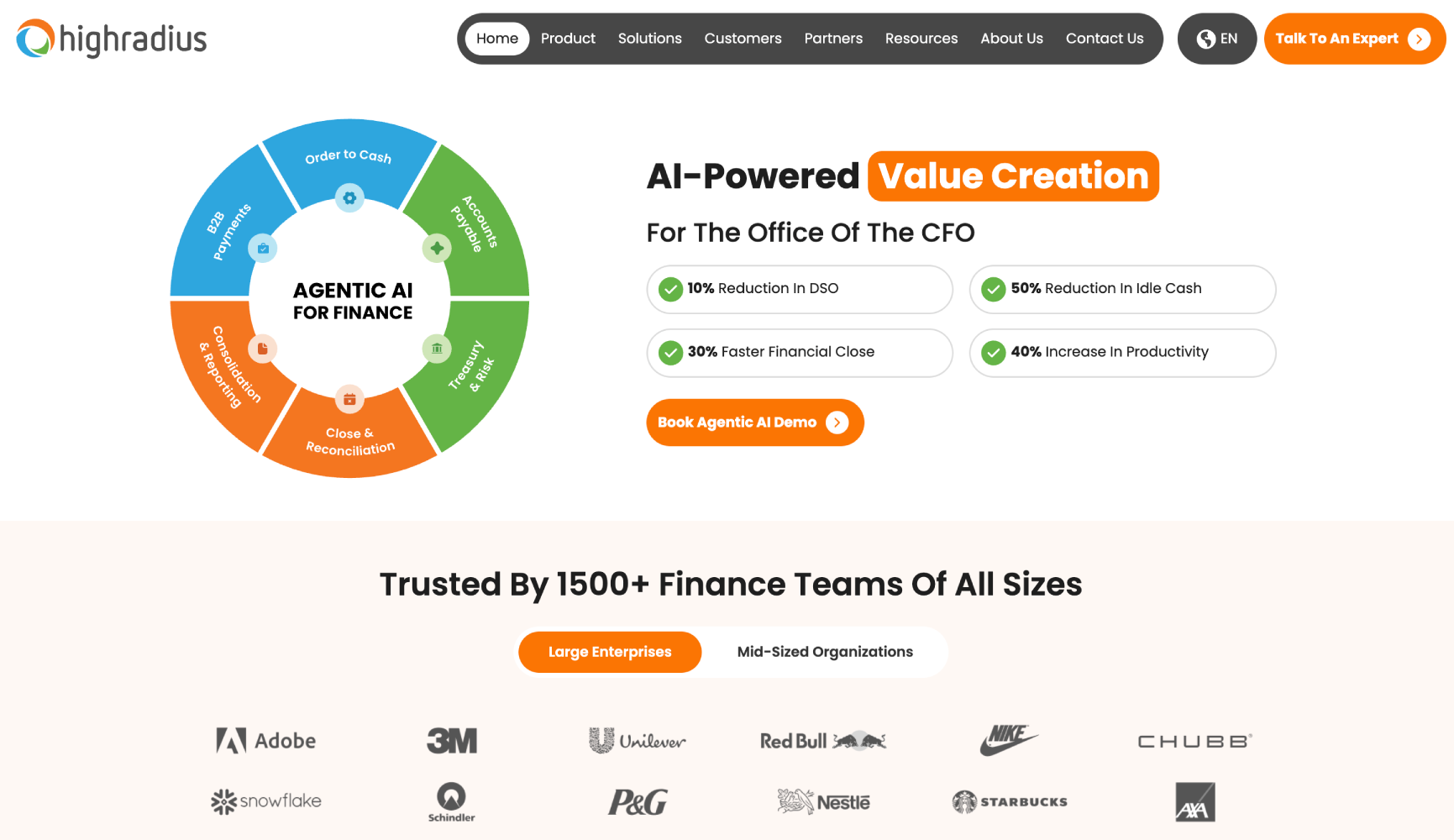
HighRadius is the most cited platform in enterprise cash application RFPs. Its Autonomous Receivables suite includes a dedicated cash application module that ingests remittance from lockbox, email, EDI, portals, and check images. The platform uses a proprietary AI engine it calls “Rivana” that applies multiple matching algorithms simultaneously rather than in sequence, which is why its match rates on mixed-format remittance hold up better than simpler rule-based competitors.
HighRadius targets AR teams at companies with over $200M in annual revenue. The implementation timeline is typically 3 to 6 months, and the platform integrates natively with SAP, Oracle, and Microsoft Dynamics. Pricing is not published and requires a contract, with deal sizes typically starting in the six-figure annual range for enterprise deployments. HighRadius also offers financial close automation, which is worth noting if your team is evaluating a broader month-end automation investment alongside cash application.
2. Billtrust
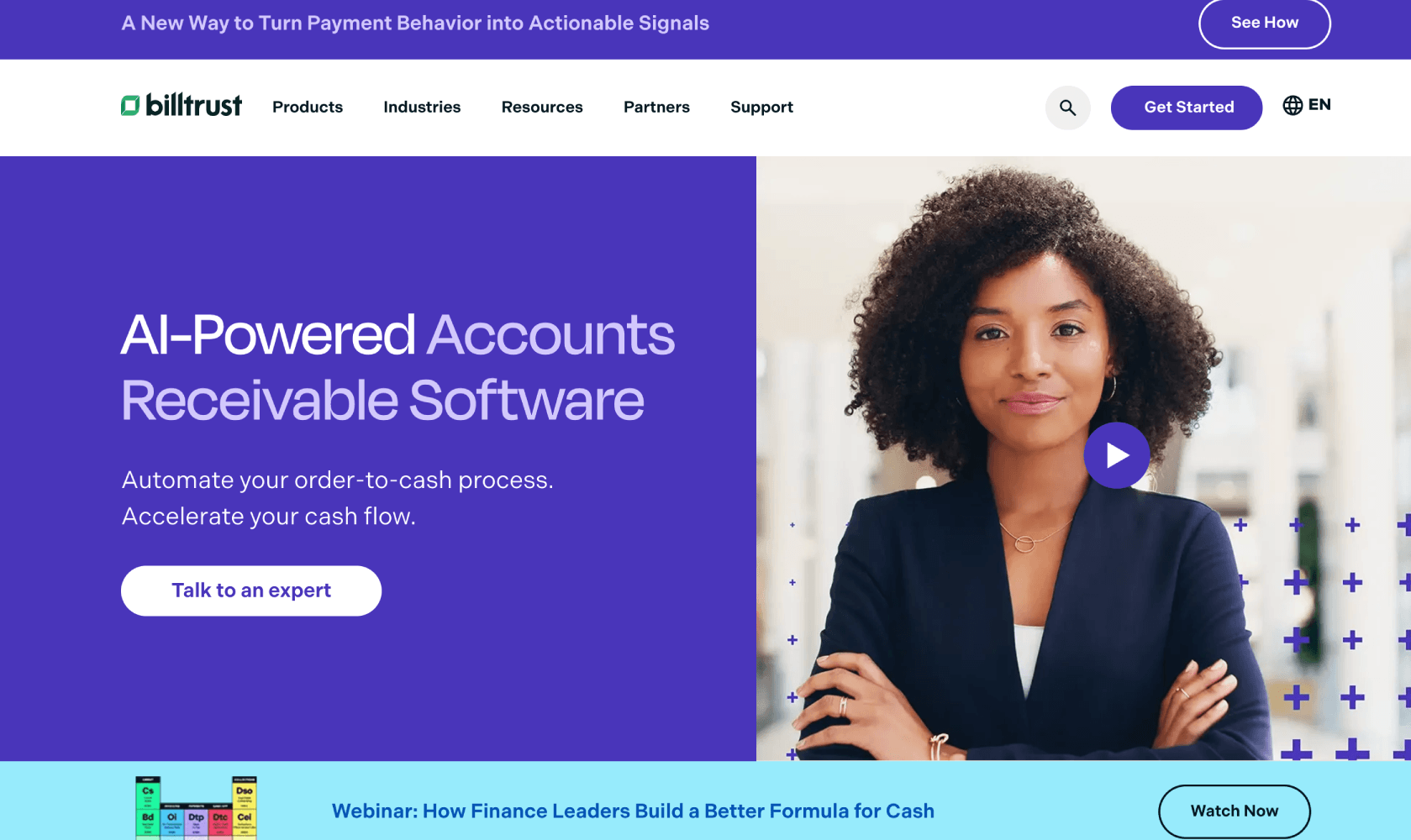
Billtrust approaches cash application as part of an order-to-cash platform rather than a standalone product. Its Cash Application module uses machine learning to match payments across all remittance formats and connects to its own Business Payments Network, which is a two-sided network where buyers can send structured remittance data directly, improving match rates for customers already on the network.
The Business Payments Network differentiator is real: when both buyer and supplier are on the network, remittance arrives pre-structured, and manual matching drops close to zero for that customer segment. For companies with a large customer base that includes many Fortune 500 buyers, this network effect compounds over time. Billtrust fits mid-market to enterprise AR teams, particularly in distribution, manufacturing, and wholesale. Pricing is custom. A detailed comparison of Billtrust in the context of competing AR platforms is covered in the Invoiced vs Versapay vs Billtrust breakdown.
3. Versapay
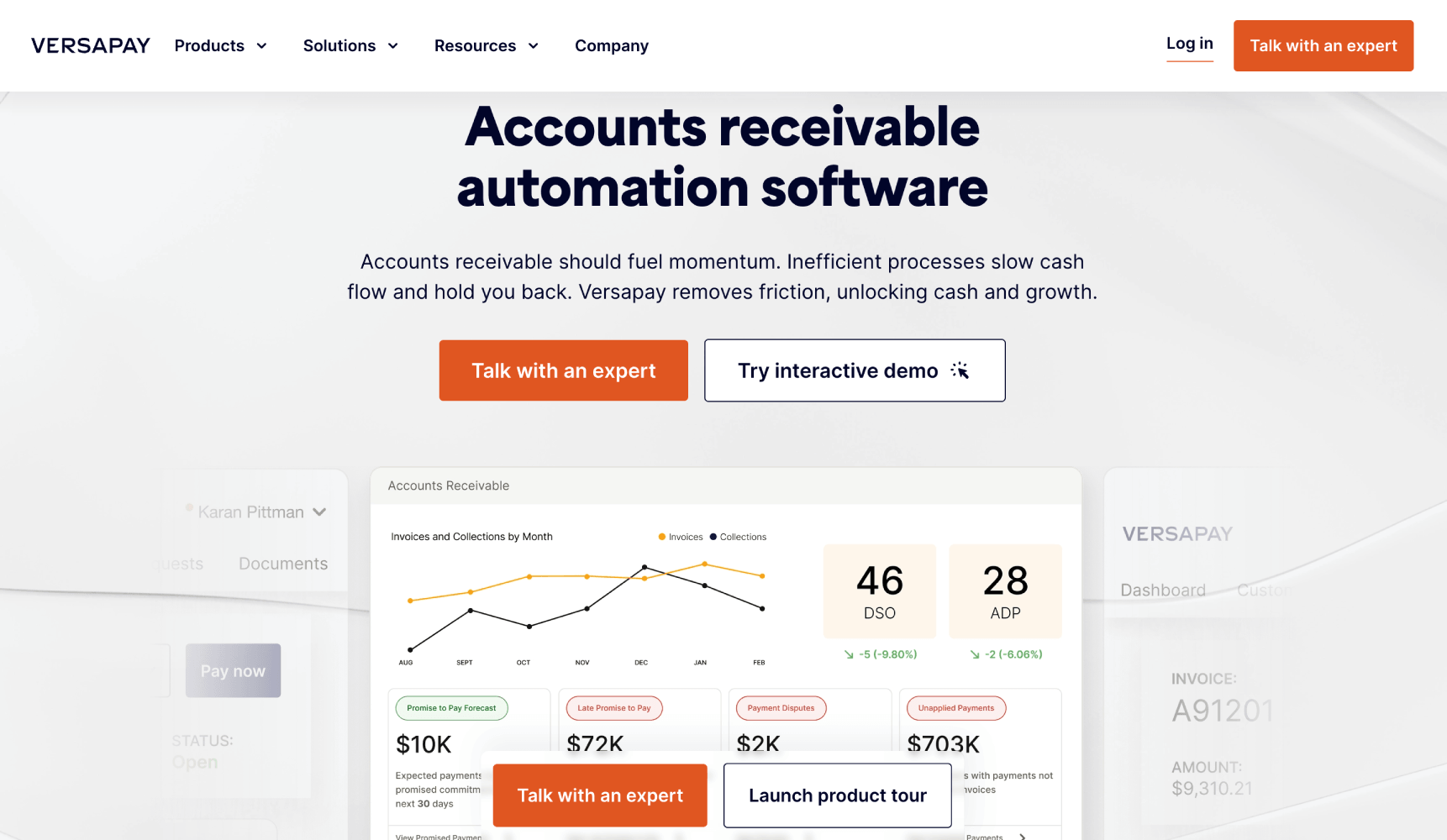
Versapay takes a collaborative AR approach that is meaningfully different from the other platforms here. Instead of only automating the supplier side, Versapay gives buyers a self-service portal where they can view invoices, dispute line items, and attach remittance at payment time. That buyer-side participation is what drives its match rates: remittance arrives already linked to invoice numbers because the buyer submitted it that way.
This design makes Versapay well-suited to companies where customer disputes and short-payments are a significant source of exception volume, not just remittance format fragmentation. It fits B2B SaaS and tech companies, professional services firms, and any business that wants to reduce inbound AR calls alongside improving match rates. Pricing is custom and deal-dependent. The platform integrates with NetSuite, Sage Intacct, and several mid-market ERPs.
4. Cforia
Cforia (now part of Corcentric) is one of the few platforms purpose-built for high-deduction industries, specifically automotive, consumer goods, and distribution. Its cash application module handles short-payment deduction coding automatically, which is a meaningful differentiator for AR teams that spend more time disputing invalid deductions than matching clean payments.
If your deduction volume is low and your main problem is remittance format fragmentation, Cforia is more platform than you need. If your team is coding 500 deductions a month and reconciling trade promotions against check payments, it is the most operationally specific tool in this list. Implementation complexity is higher than average, and the platform targets large enterprises. Pricing is not public.
5. Esker
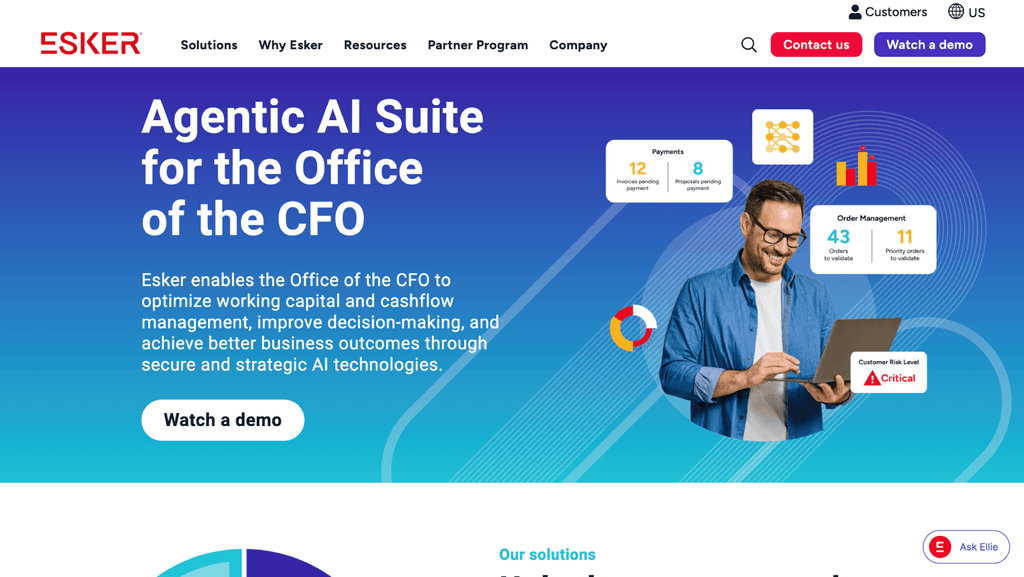
Esker is a document process automation platform that includes cash application as part of its order-to-cash suite. Its AI-driven cash application module reads remittance from email, PDF, EDI, lockbox, and bank files, and its matching engine uses a combination of fuzzy logic and ML models trained on historical payment data.
Esker’s strength is its breadth: it handles the full AR cycle from order management to collections, which matters for finance teams that want a single vendor relationship rather than point solutions stitched together. It is particularly strong in manufacturing and distribution, and it has deep SAP integration. Pricing is not published. Implementation runs roughly 8 to 16 weeks depending on ERP environment and remittance source complexity.
6. Tesorio
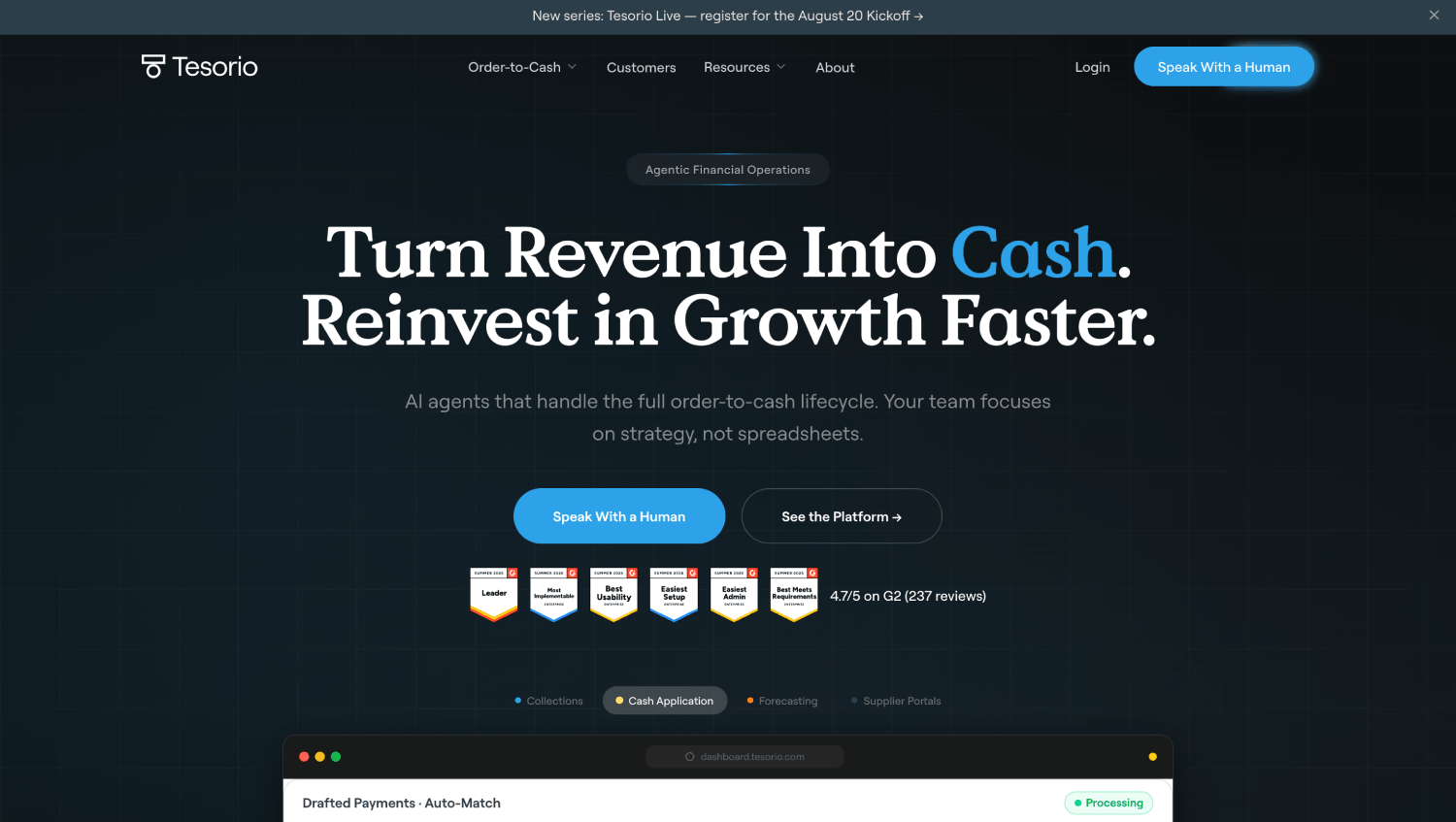
Tesorio is primarily a cash flow forecasting and collections platform, but its cash application capabilities are more tightly integrated with cash flow visibility than most dedicated AR tools. When a payment matches, it feeds directly into Tesorio’s forecasting models, which means your rolling cash forecast updates in near real time rather than after a batch posting cycle.
This integration between payment matching and treasury visibility is why Tesorio attracts Series B through Series D SaaS companies with active finance and FinOps functions. It is not the strongest standalone cash application engine by raw match rate. Its value is the downstream cash intelligence. Pricing is not public, and the platform targets companies with $10M or more in ARR.
7. Kolleno
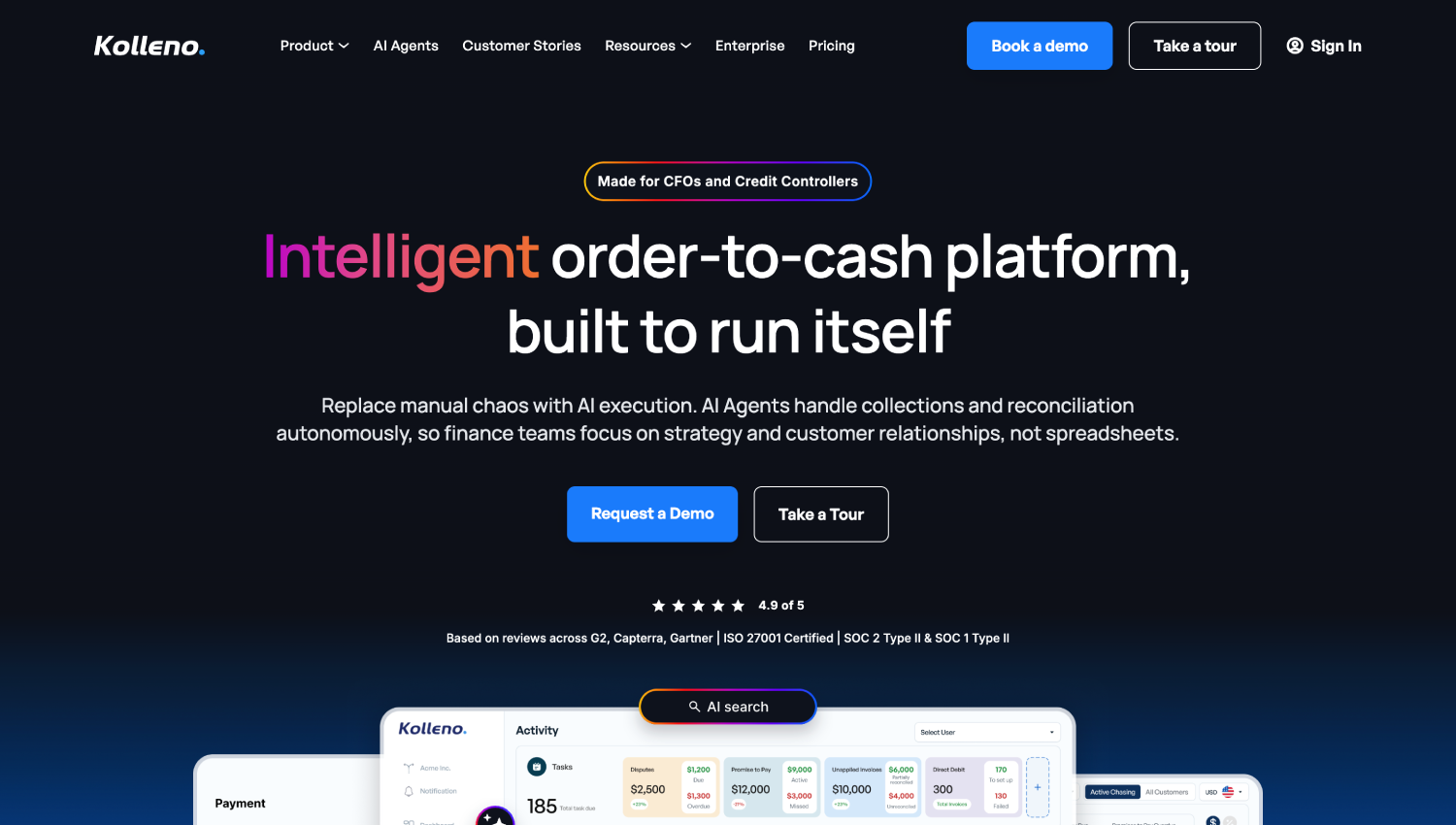
Kolleno is an AR management platform built for mid-market B2B companies, with cash application, collections automation, and credit risk monitoring in one product. Its cash application module auto-matches payments to invoices and flags discrepancies, with an exception workflow that routes items to the right team member based on customer segment or amount threshold.
Kolleno is the most accessible option in this list for companies under 500 employees that do not have dedicated AR operations staff. The onboarding process is faster than enterprise competitors, and it integrates with Xero, QuickBooks, NetSuite, and Sage. Pricing is not published at the enterprise tier, but it has lower entry-point commitments than HighRadius or Billtrust.
8. BlackLine AR Automation
BlackLine is best known for financial close automation, but its AR Intelligence module includes cash application capabilities that sit inside the same platform finance teams use for reconciliations and journal entries. For companies already running BlackLine for close management, adding AR cash application avoids a separate vendor integration and keeps all matching data in the same audit trail.
The trade-off is specialization. BlackLine’s cash application is not as deep as HighRadius or Billtrust on AI-driven remittance ingestion. It fits finance teams that prioritize platform consolidation and audit trail cohesion over maximum match rate optimization. Pricing is contract-based.
9. YayPay (by Quadient)
YayPay, now part of Quadient’s AR automation suite, offers cash application alongside collections automation and customer self-service. Its matching engine handles standard remittance formats and connects to Salesforce, NetSuite, Sage Intacct, and Microsoft Dynamics. Quadient’s acquisition brought document management depth that improves remittance capture from PDF and email formats.
YayPay fits mid-market companies that want AR automation bundled with collections and AR analytics without the implementation overhead of an enterprise platform. It is a reasonable choice for B2B SaaS companies between $5M and $50M ARR that are outgrowing spreadsheet-based cash application. Pricing is available on request.
How Do These Platforms Compare on Match Rate and Use Case?
| Platform | Reported Auto-Match Rate | Best For | ERP Integration | Pricing Model |
|---|---|---|---|---|
| HighRadius | Up to 95%+ | Enterprise AR operations | SAP, Oracle, Dynamics | Custom contract |
| Billtrust | High (network-dependent) | Mid-market to enterprise with B2P Network buyers | SAP, Oracle, Dynamics | Custom contract |
| Versapay | High (buyer portal-driven) | B2B SaaS, dispute-heavy AR | NetSuite, Sage Intacct | Custom contract |
| Cforia | High in deduction environments | Manufacturing, auto, high-deduction distribution | SAP, Oracle | Custom contract |
| Esker | High (multi-source ingestion) | Manufacturing, distribution, SAP shops | SAP, Oracle, others | Custom contract |
| Tesorio | Moderate (cash flow focus) | SaaS with cash forecasting needs | NetSuite, Sage Intacct | Custom contract |
| Kolleno | Good for mid-market volume | Sub-500 employee B2B companies | Xero, QBO, NetSuite | Custom (lower entry) |
| BlackLine AR | Standard (close-integrated) | Finance teams on BlackLine already | SAP, Oracle | Custom contract |
| YayPay (Quadient) | Good for mid-market | Mid-market B2B SaaS, Salesforce users | NetSuite, Salesforce, Dynamics | Custom contract |
Match rate figures above reflect vendor-reported ranges and customer case study data. Actual rates vary by remittance format complexity, customer payment behavior, and ERP environment. Request a match rate proof of concept on your own historical data before signing any contract.
What Does the Cash Application Buying Process Actually Look Like?
None of these vendors publish per-invoice or per-transaction pricing. Every deal is scoped based on invoice volume, payment method mix, ERP environment, and number of remittance sources. A company processing 5,000 invoices a month will pay substantially less than one processing 50,000, but the pricing structures are not linear and are not disclosed publicly.
The typical procurement path runs: discovery call, data audit (the vendor reviews a sample of your remittance files and ERP data), a proof of concept or sandbox demo using your data, and then a contract proposal. The POC step is the most valuable part of the process. Any vendor unwilling to run a match rate test against your actual historical payment and remittance data before contract signature is a red flag.
Implementation timelines range from 6 weeks for a mid-market SaaS company on NetSuite with simple remittance formats, to 6 months for an enterprise manufacturer with SAP, EDI 820, lockbox files, and hundreds of deduction reason codes. Budget for internal IT time regardless of what the vendor estimates. For context on evaluating vendor contracts and implementation risk more broadly, the FintechSpecs fintech vendor evaluation framework covers the same due diligence principles.
What Should You Ask During a Cash Application Software Demo?
Most demos show the platform working on clean, pre-formatted data. Push past the scripted walkthrough with these specific questions:
- What is the match rate for check payments with no structured remittance attached? This is where most tools fail.
- How does the exception queue handle payments that span multiple invoice numbers across multiple business units?
- What happens when a customer consistently short-pays by 2% as a standard practice? Does the system learn to auto-match the short payment or flag it every time?
- How long does it take the ML model to adapt when a customer changes their remittance format?
- What is the process for handling unapplied cash and on-account payments?
- Can you show the ERP posting logic for a split payment against three invoices, including the debit memo for the short-payment portion?
If the sales engineer pauses on questions 1, 3, or 6, take note. Those are the scenarios that create AR backlogs in production environments.
How Does Cash Application Automation Connect to Broader AR Operations?
Cash application sits at the intersection of collections, credit, and cash forecasting. Getting payments matched faster and more accurately shortens DSO directly, but the downstream effects matter too. A clean, real-time cash application function means your collections team is calling on actual open invoices instead of ones that were paid three days ago and not yet posted. Your credit team can see updated customer balances before releasing a new order. Your FP&A team can build a rolling cash forecast on current data rather than a two-day-old ERP snapshot.
This is why several platforms in this list, particularly Tesorio and Versapay, position cash application as a component of a broader AR intelligence layer rather than a standalone matching engine. If your finance team is also evaluating payment reconciliation software for bank-side matching, the two functions are complementary but distinct. Cash application matches remittance to AR invoices. Payment reconciliation matches bank statement lines to general ledger entries. Some platforms handle both; most specialize in one.
For growing B2B SaaS companies, automating cash application often surfaces a secondary problem: the invoicing and billing infrastructure generating the receivables is not producing clean invoice data that the matching engine can work with. If that is the case, the right starting point might be the invoicing API layer before or alongside the cash application tool.
Frequently Asked Questions About Cash Application Software
What is auto-match rate and why does it matter?
Auto-match rate is the percentage of incoming payments that the software matches to open invoices without human intervention. A rate of 85% means 85 out of every 100 payments post automatically. The remaining 15% go to an exception queue for review. Higher match rates reduce AR clerk labor hours directly. In practice, the difference between a 75% and a 90% match rate at 10,000 monthly payments is roughly 1,500 fewer manual touch events per month.
Can cash application software handle partial payments and deductions?
Yes, the better platforms handle partial payments, short-pays, and deductions as distinct workflow categories rather than treating them all as unmatched exceptions. Platforms like Cforia are specifically built to code deduction reason types automatically. Most enterprise platforms can match a payment to the invoices it covers and auto-generate a debit memo or chargeback for the short-pay amount, routing it to a deductions analyst rather than an AR clerk.
How long does cash application software implementation take?
Implementation typically runs 6 to 16 weeks for mid-market companies and 3 to 6 months for enterprise deployments with multiple ERP environments, EDI connections, and lockbox configurations. The primary variables are ERP integration complexity, number of remittance source types, and whether historical payment data is available to train the matching model before go-live. Clean historical data accelerates the ML training cycle significantly.
Does cash application software require EDI to work well?
No. Modern platforms ingest remittance from email body text, PDF attachments, web portals, ACH addenda fields, and bank image files in addition to EDI 820 files. EDI produces the cleanest structured data and typically yields the highest match rates, but the AI-driven platforms on this list are specifically designed to handle unstructured remittance. Match rates for non-EDI sources are lower but still meaningfully above manual baseline performance.
What ERP systems do cash application tools typically integrate with?
SAP S/4HANA and SAP ECC, Oracle ERP Cloud, Oracle E-Business Suite, Microsoft Dynamics 365, NetSuite, Sage Intacct, and Sage X3 cover the majority of deployments. Enterprise platforms (HighRadius, Billtrust, Esker, Cforia) prioritize SAP and Oracle depth. Mid-market tools (Versapay, Kolleno, YayPay) focus on NetSuite, Sage Intacct, and QuickBooks. Most offer API connectivity for ERPs outside their native integration list.
Is cash application software the same as accounts receivable automation?
Cash application is one function within the broader AR automation category. A full AR automation platform typically covers credit management, invoice delivery, customer self-service, collections workflow, cash application, and deductions management. Cash application specifically refers to matching incoming payments to open invoices. Some companies buy standalone cash application tools; others buy it as part of a complete order-to-cash suite. Standalone tools generally offer deeper matching functionality; suite products offer better cross-functional visibility.
How is automated cash application priced?
No vendor in this category publishes standard pricing as of mid-2026. Pricing is scoped per deal and based primarily on annual invoice volume, number of legal entities, ERP environment complexity, and remittance source count. Enterprise contracts typically run five to six figures annually. Mid-market platforms tend to have lower minimums but still require a custom quote. Requesting a price-per-invoice benchmark during negotiations is a useful anchoring tactic.
What is the difference between cash application and payment reconciliation?
Cash application matches incoming customer payments to AR invoices in the accounts receivable subledger. Payment reconciliation matches bank statement transactions to general ledger entries, confirming that what your bank received equals what your books show. The two processes address different matching problems and sit at different points in the finance workflow. Some platforms cover both; most specialize in one. A company that solves cash application first typically reduces the volume of reconciliation exceptions downstream.
Conclusion
The case for cash application automation is not about replacing AR staff. It is about redirecting their time. A team that spends 60% of its week manually matching payments and 40% on exception management and collections flips those numbers with the right platform. The 40% that cannot be automated, the true exceptions, disputes, and deduction coding decisions, actually requires skilled judgment. The 60% that can be automated does not.
Choosing between these nine platforms comes down to two variables before anything else: your ERP environment and your primary exception type. If you run SAP and deal with high deduction volume, Cforia or Esker outperforms a general-purpose platform regardless of overall match rate claims. If you run NetSuite and your main problem is remittance format fragmentation across 300 small customers, Versapay or Kolleno reaches a productive match rate faster and at lower implementation cost. HighRadius and Billtrust are the right answers when scale, network effects, and enterprise SLA requirements justify the contract size and implementation timeline.
Run the MERIT Framework against your top two or three candidates. Require a match rate POC on your own historical data. The platform that wins that test with your specific customer payment patterns will hold up in production. One that only performs well on clean demo data will not.