
- ChatGPT does not cite pages because they rank well on Google. It cites pages that contain extractable, entity-rich, directly answerable content structured in ways its retrieval systems recognize.
- Most content fails LLM retrieval because it buries answers in prose, uses vague entity references, and lacks the structural signals that distinguish a cited source from background noise.
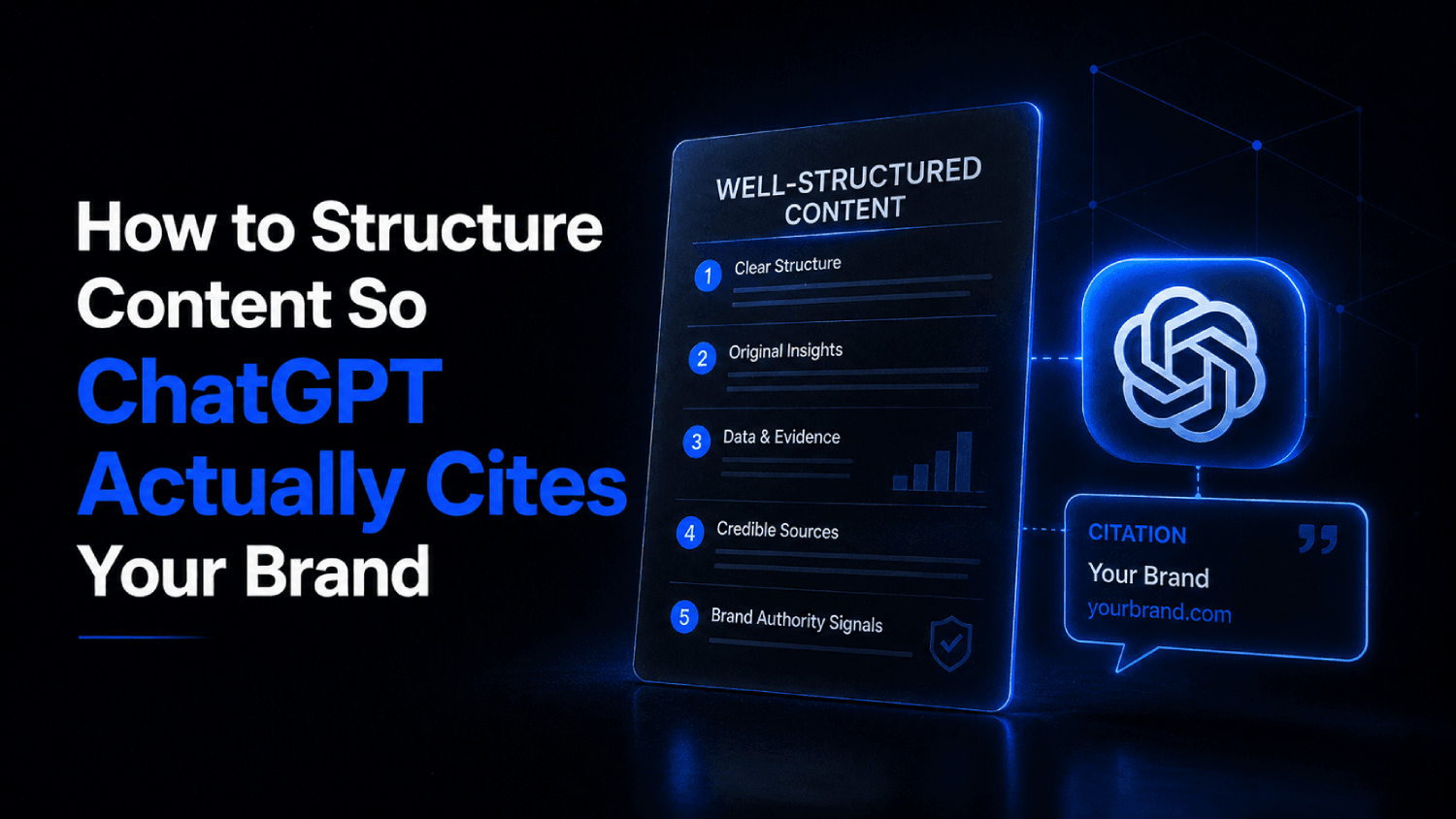
- The FintechSpecs Citation Architecture Framework identifies five structural layers every page needs: an answer block, a definition section, an entity box, a comparison table, and a reinforcement cluster across related pages.
- Publishing more content does not raise citation probability. Publishing better-structured content on fewer, well-chosen topics does.
- Templates for all five structural elements are included below, ready to apply to existing pages.
To get cited by ChatGPT, structure each page so that every major section delivers a complete, self-contained answer to a single query. Use explicit entity names, include a definition section near the top, place your core answer in the first two sentences of each H2, and reinforce the same claims across multiple related pages on your site. That is how to structure content for ChatGPT citations: format beats volume every time.
Why Most Content Never Gets Cited by ChatGPT
ChatGPT’s retrieval systems, whether pulling from its training corpus or from live web retrieval in tools like ChatGPT Search, weight content differently than Google’s crawlers do. Google rewards topical authority and backlink graphs. LLMs reward extractability: how quickly and clearly a passage can be lifted and presented as an answer without losing meaning.
Most B2B content fails this test because it was written for human reading flow, not machine extraction. The answer to a key question appears in paragraph seven. The company or product name appears once, without context. The page covers three overlapping ideas in one section, making it impossible for a retrieval system to clip a clean passage.
The result is that pages with strong domain authority on Google go uncited in AI answers, while lesser-known pages that follow better structural patterns get surfaced repeatedly. This is the gap most content teams have not closed yet.
What the FintechSpecs Citation Architecture Framework Actually Covers
The FintechSpecs Citation Architecture Framework is a five-layer structural model for pages that need to rank in LLM outputs. Each layer corresponds to a content element that increases the probability of a retrieval system identifying your page as the best answer to a specific query. The layers are not additive in a simple sense: missing one of the first three drops citation probability significantly, regardless of how well the others are executed.
The five layers are: an answer block at the top of each major section, a definition section early in the page, an entity box for the primary subject, at least one comparison table for any claim involving multiple options, and a reinforcement cluster of related pages that cite or echo the same core claims. Each is described below with a working template.
Layer 1: The Answer Block
An answer block is a short, self-contained passage that opens every major section with a direct response to the query that section addresses. It contains a factual sentence, followed by two to four supporting sentences or bullets. It does not require the reader to have read the rest of the article to understand it.
According to Evertune’s published research on ChatGPT citation patterns, pages that get cited by ChatGPT tend to share measurable structural characteristics , including shorter average sentence lengths of around 17 words , structured into scannable chunks rather than long blocks. These figures are averages across the pages Evertune studied, not prescriptive targets, and should be treated as directional signals rather than hard rules. The answer block is the most direct implementation of that pattern.
Answer Block Template:
[One-sentence direct answer to the section’s core query.] [One to two sentences of supporting evidence or mechanism.] [One to two bullets with specific, named details.]
Example for a fintech content page:
Merchant of record services handle tax liability on behalf of the software vendor. This means the vendor does not register for VAT or sales tax in each jurisdiction where it sells. Platforms that operate as merchant of record include Paddle and Lemon Squeezy. The tradeoff is reduced control over checkout flow and a percentage fee on gross revenue.
Notice that this passage can be extracted verbatim and placed into an LLM response without editing. That is the goal. For a deeper comparison of how these platforms differ on other dimensions, the merchant of record decision for B2B SaaS founders covers the trade-offs in detail.
Layer 2: The Definition Section
LLMs treat definition passages as high-confidence anchor points. When a retrieval system is building an answer about a concept, it frequently pulls from the page that defines the concept most cleanly, not the page that discusses it most broadly.
A definition section should appear early, ideally within the first 200 words of the page, and should follow a consistent format: term, what it is, what it is not, and why it matters in this context.
Definition Section Template:
Example:
LLM citation optimization
What it is: The practice of structuring content so large language models retrieve and attribute it when generating answers to related queries.
What it is not: A synonym for SEO, though the two overlap in entity richness and authority signals.
Why it matters here: AI search tools like ChatGPT, Perplexity, and Google AI Overviews increasingly drive top-of-funnel discovery for B2B buyers, and pages that are not structured for LLM retrieval do not appear in those answers regardless of their Google ranking.
Layer 3: The Entity Box
Entity density is one of the clearest signals that separates cited pages from uncited ones. LLMs are trained on and retrieve from content that names specific companies, products, people, standards, and dates, not content that describes them vaguely.
An entity box is a structured block near the top of the page that explicitly names the primary entities the page covers. It gives retrieval systems an immediate map of what the page is about.
Entity Box Template:
| Entity Type | Named Entities on This Page |
|---|---|
| Companies | [List every company mentioned by name] |
| Products / Platforms | [List every product or platform mentioned] |
| Standards / Regulations | [List any regulatory standards, frameworks, or specifications] |
| Key People | [Named individuals, if any] |
| Primary Topic | [The exact concept this page is authoritative on] |
In practice, this block can be formatted as a small table in a sidebar, embedded within the introduction, or placed in a structured data block invisible to readers but readable to crawlers. The named entities themselves are what matter.
Layer 4: The Comparison Table
Comparison tables are among the most-cited content structures in LLM outputs. They compress a large amount of structured information into a format that can be extracted cleanly, and they signal that the page has done the analytical work a reader (or model) would otherwise have to do manually.
Every page making a comparative claim, even implicitly, should include at least one table. The table should have explicit column headers, named entities in rows, and factual values (not adjectives) in cells.
Comparison Table Template:
| Option | Best For | Key Differentiator | Primary Limitation | Pricing Model |
|---|---|---|---|---|
| [Option A] | [Specific use case or buyer type] | [One factual differentiator] | [One factual limitation] | [Public pricing or “not publicly disclosed”] |
| [Option B] | [Specific use case or buyer type] | [One factual differentiator] | [One factual limitation] | [Public pricing or “not publicly disclosed”] |
| [Option C] | [Specific use case or buyer type] | [One factual differentiator] | [One factual limitation] | [Public pricing or “not publicly disclosed”] |
Fill every cell with a factual value. Cells containing “N/A” or blank entries reduce the table’s extraction value. If pricing is not public, say so explicitly in the cell. That is itself useful information to a retrieval system.
Layer 5: The Reinforcement Cluster
A single well-structured page raises your citation probability for one query. A cluster of related, interlinked pages that each reinforce the same core claims raises it for a family of queries, and it signals to LLM systems that your site is an authoritative source on a topic rather than a one-off article.
A reinforcement cluster requires three to five pages that share a topic, cross-link to each other on descriptive anchor text, and each independently contain answer blocks on related sub-queries. The links do not have to be new content. Updating existing pages to add answer blocks and cross-links to a newly published cornerstone page is faster and often more effective.
For teams building GEO-oriented content strategy from scratch, the distinction between traditional SEO and AI search visibility is explored in GEO vs SEO for B2B SaaS. The underlying mechanics of why AI search changes buyer behavior, particularly at the research stage, are covered in how AI search is changing B2B fintech buyer behavior.
How to Apply the Framework to Existing Content
Most teams do not need to write new pages. They need to restructure existing ones. A typical 1,500-word B2B article contains the raw material for all five layers but buries it inside flowing prose. The work is architectural, not editorial.
Run each existing page through this checklist:
- Does the page open within its first H2 with a direct, one-sentence answer to the query that H2 represents? If not, add an answer block.
- Is the primary concept on the page defined explicitly, in the first 200 words, in a format that can be extracted without context? If not, add a definition section.
- Are all companies, products, and standards named explicitly at least once, with context? If not, expand entity references throughout.
- Does any comparative claim appear in a table? If not, convert the relevant prose section to a table.
- Are there two to four other pages on the site that cover related sub-queries and link to this page on descriptive anchor text? If not, identify the closest candidates and add links.
A page that passes all five checks has a materially higher probability of being retrieved by ChatGPT, Perplexity, and Google AI Overviews than a page that passes one or two.
What the Evertune Research Actually Says About Page Structure
According to Evertune’s published research on ChatGPT citation patterns, pages that get cited tend to share measurable structural characteristics: approximately 941 words in length, around 18 paragraphs, average sentence lengths near 17 words, approximately four H2 headers, and two H3 headers. Evertune also found that cited pages include roughly 28 internal links and 15 external links on average.
These are averages from a single research source , Evertune has not published the full methodology or dataset publicly, so independent verification is not currently possible. Treat them as directional signals, not engineering specs. Chasing any of these numbers mechanically without improving content quality produces nothing. The pattern they describe is coherent: concise, well-linked, moderately structured pages outperform dense, long-form walls of text in LLM retrieval. The answer block format this article recommends is the content-level implementation of what those structural averages suggest.
The 28 internal links figure warrants a note: this article itself does not contain 28 internal links, and most individual fintech content pages will not either. The Evertune average likely reflects pages with extensive navigational link structures, sidebars, or footers counted in the total , not 28 in-content contextual links. What matters practically is building a cluster where pages link to each other meaningfully, not hitting a specific count. For fintech content specifically, a strong internal link structure also signals topical depth to LLMs: a page about API infrastructure that links to pages about fraud tools, compliance requirements, and payment processors tells a retrieval system that the site covers the topic at a systems level, not just as a single post. Teams building out this kind of topical coverage can use the 10 best fintech APIs for SaaS as a reference for how entity-dense link structures look in practice.
How to Write for LLM Retrieval Without Destroying Readability
The concern most content teams raise here is real: answer blocks and definition sections can feel clinical if they are stacked mechanically without surrounding context. The solution is sequencing, not choice. Answer blocks belong at the opening of each section. Prose and analysis follow them. The two coexist on the same page, serving different readers (and retrieval systems) at different points.
A page structured for LLM citation does not read like a FAQ sheet. It reads like a well-organized article where the key point of each section is immediately clear. That also happens to be good writing.
One structural pattern that helps: write the answer block first, then write the explanatory prose below it as if the reader asked “why?” or “how does that work?” The answer block handles retrieval. The prose handles comprehension and trust-building. Neither sacrifices the other.
FAQ: LLM Citation Optimization for Content Teams
Does page length affect ChatGPT citation probability?
According to Evertune’s research, pages cited by ChatGPT average around 941 words , shorter than most long-form SEO content. This does not mean cutting content arbitrarily. It means that dense, concise pages with clear structure outperform long pages that bury answers in prose. If a page exceeds 2,000 words, splitting it into two tightly focused pages often improves retrieval performance for both. Note that this 941-word average comes from Evertune’s dataset; the underlying sample size and selection criteria are not publicly documented.
Do external links help LLMs decide whether to cite a page?
Named source citations within the content function as credibility signals for LLM retrieval systems. A page that attributes claims to specific companies, research sources, or public documents reads as more authoritative than one that states facts without attribution. External links alone do not drive citation, but inline attribution with named sources does. The practice of writing “According to Stripe’s public pricing page…” is more valuable for LLM purposes than adding a footnote link.
What is the difference between GEO and traditional SEO for content structure?
Traditional SEO optimizes for crawler signals: keyword density, backlink profile, page speed, and metadata. Generative Engine Optimization (GEO) optimizes for extractability: how cleanly a retrieval system can lift a passage and present it as an answer. GEO requires structural changes at the content level, including answer blocks, explicit entity naming, and definition sections, that traditional SEO does not require and sometimes works against by encouraging longer, more conversational prose. For a full breakdown, see what generative engine optimization means for fintech SaaS.
How many internal links does a page need to perform well in LLM retrieval?
Evertune’s research found an average of 28 internal links per cited page , significantly higher than most content strategies target. As noted above, that figure likely includes navigational and structural links beyond in-content contextual links, and Evertune has not published the counting methodology. The practical takeaway is directional: build mutual links across a topic cluster rather than treating pages as standalone documents. Clusters of mutually linked pages signal topical depth to LLM systems in a way that isolated well-written pages cannot replicate.
Can you structure content for AI citations without hurting Google rankings?
The structural changes that improve LLM citation probability, clearer H2s, answer blocks, explicit entity naming, shorter paragraphs, and comparison tables, overlap significantly with what improves Google’s Featured Snippet and AI Overview selections. The two strategies are largely compatible. The main divergence is length: SEO often rewards comprehensive coverage, while LLM retrieval rewards density and concision. The practical resolution is to write short, structured sections that can be expanded with supporting prose below each answer block.
Does publishing frequency affect LLM citation rates?
Publishing frequency matters less than publishing coverage. A site with 15 tightly structured, interlinked pages on a specific topic cluster will be cited more frequently than a site with 150 loosely related articles on scattered subjects. LLMs weight topical consistency and entity coherence. For fintech content, this means building deep coverage on a defined topic, such as payment infrastructure or compliance architecture, rather than producing broad editorial calendars across unrelated fintech subjects.
What role does schema markup play in LLM citation optimization?
Schema markup, including FAQ schema, HowTo schema, and Article schema, helps LLMs and AI overview systems identify content types and extract structured answers. FAQ schema in particular maps directly to the question-answer format that AI search tools surface. It is not a substitute for good content structure, but it reinforces the structural signals the content already contains. Any page with an FAQ section should have FAQ schema implemented.
Do LLMs struggle with citing sources accurately?
Yes. LLMs frequently hallucinate citations, attribute claims to incorrect sources, or omit source attribution entirely when the underlying content was not structured to signal authorship and origin. Pages that include a clear byline, publication date, explicit inline attribution (“According to [Source]…”), and a named entity box reduce the probability of misattribution. Structured content does not eliminate LLM citation errors, but it gives the model more accurate signals to work from.
The Full Citation Architecture Checklist
| Layer | Element | Check |
|---|---|---|
| Layer 1 | Answer Block | Every H2 opens with a direct one-to-two sentence answer, no preamble |
| Layer 2 | Definition Section | Primary term defined within first 200 words using What/What It Is Not/Why It Matters format |
| Layer 3 | Entity Box | All named companies, products, standards, and people listed explicitly near page top |
| Layer 4 | Comparison Table | Any comparative claim rendered as a table with factual values, no adjectives in cells |
| Layer 5 | Reinforcement Cluster | Three to five related pages link to this page on descriptive anchor text; this page links back |
| Support | Internal Link Density | Build mutual links across pages in the cluster; the 28-link average from Evertune is a research observation, not a per-page target |
| Support | Inline Attribution | Every factual claim names its source inline, not in a footnote |
| Support | FAQ Schema | FAQ section present and marked up with FAQ schema where applicable |
| Support | Sentence Length | Average sentence length held near 17 words per the Evertune cited-page pattern (directional average, not a hard rule) |
| Support | Byline and Date | Author name and publication date present and machine-readable |
For teams prioritizing which pages to update first, sort by current organic traffic and business relevance, then apply the checklist top-down. A high-traffic page that already ranks but does not appear in AI answers is the best candidate: it has proven demand and just needs the structural layers added. For a practical look at how fintech operators assess which tools and systems warrant this level of structural investment, the tools fintech ops teams actually use daily shows how practitioners evaluate infrastructure in a similar decision framework.
Why Reinforcement Clusters Outperform Single Pages Every Time
The single biggest structural mistake content teams make when targeting LLM citations is optimizing individual pages in isolation. A perfectly structured page that sits in a topical vacuum, with no related pages reinforcing its claims and no incoming internal links, will be retrieved sporadically at best.
LLMs treat topical clusters as coherent knowledge sources. A site where five pages each address a facet of the same underlying question, and each cites the others, signals something closer to encyclopedic coverage than a single strong post does. That signal raises attribution confidence: the model is more likely to name the source explicitly when it has encountered the same claims across multiple related pages.
This is also why GEO agencies focused on fintech content prioritize cluster architecture over individual page scoring. For teams evaluating outside help, the best GEO agencies for fintech SaaS breaks down what separates cluster-oriented firms from those still running traditional SEO playbooks under a GEO label.
The One Structural Mistake That Eliminates Citation Potential Immediately
Burying the answer. When a page’s key claim appears in the fourth paragraph, behind scene-setting and context-building, a retrieval system either passes over it entirely or pulls an earlier, less accurate passage instead. The content is correct but structurally invisible to the model.
This is not a writing quality problem. It is an architecture problem, and it is the most common reason well-researched pages go uncited. The fix is mechanical: move the answer to the top of every section, without removing the supporting evidence below it. The work takes minutes per page. The structural debt most teams carry across dozens of existing articles makes this the highest-return optimization available.
Content volume has never been the bottleneck for LLM citations. Most sites already have enough pages. What they do not have is pages where every major answer is placed exactly where a retrieval system expects to find it, named explicitly, supported by structured evidence, and echoed across related pages. Fix the architecture, and the citations follow.