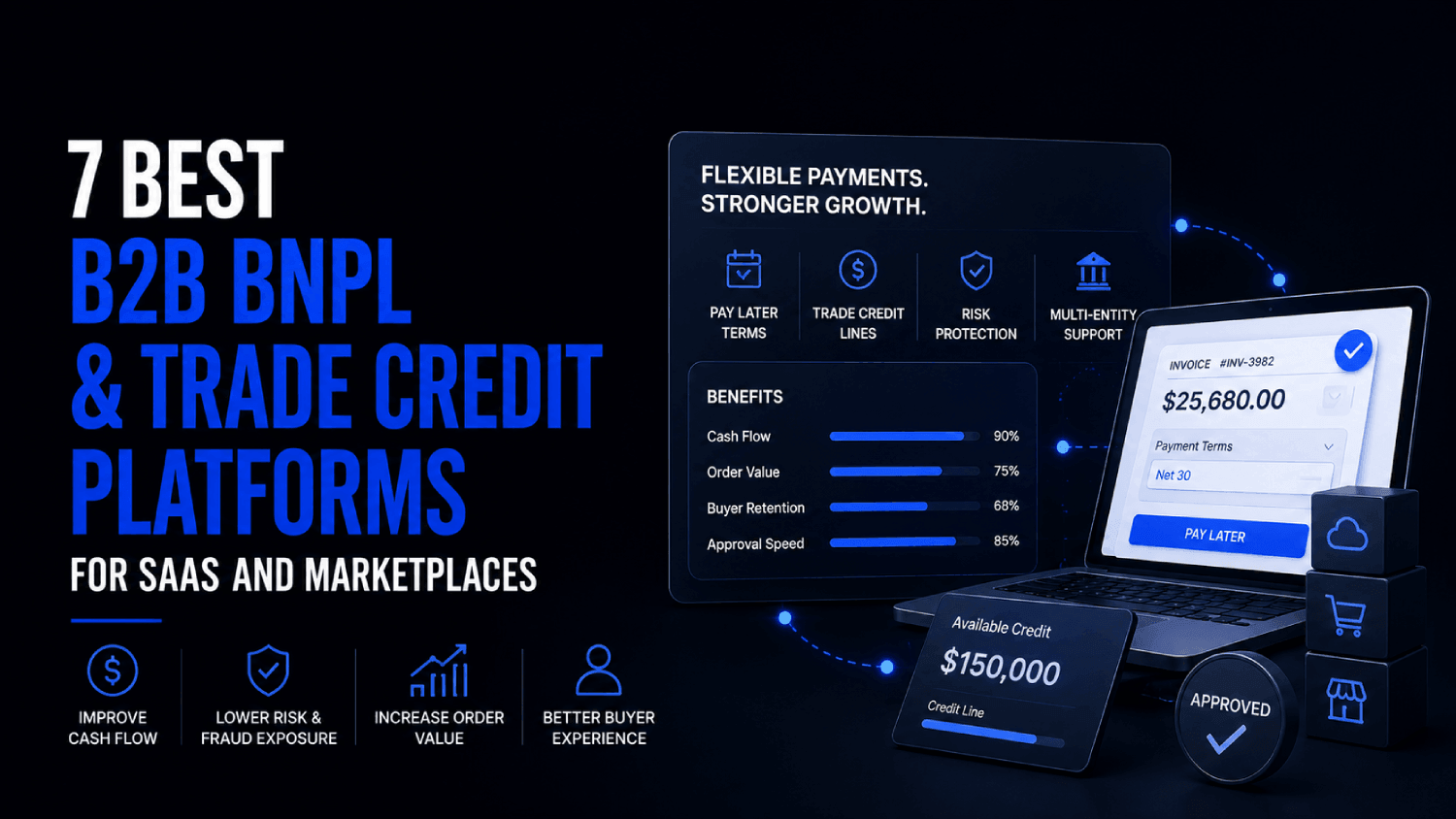

- B2B BNPL platforms underwrite your buyers and pay you upfront, eliminating AR risk and invoice chasing from your side of the equation.
- Balance, Resolve, Slope, Mondu, TreviPay, Hokodo, and Behalf are the shortlist for US-available embedded trade credit in 2026.
- The core split: API-first platforms (Balance, Slope) for marketplaces and SaaS embedding credit into checkout; managed-network platforms (TreviPay, Resolve) for established B2B merchants wanting faster deployment.
- Buyer credit limits, underwriting speed, and who holds the lending license matter more than fee structure when choosing a provider.
- Most platforms charge merchants a discount rate of 1.5% to 5% per transaction; you price that in or pass it through depending on your margin structure.
The best B2B BNPL providers for SaaS and marketplace platforms are Balance, Resolve, Slope, Mondu, TreviPay, Hokodo, and Behalf. Each underwrites your buyers independently, pays you upfront, and handles collections, so you are never carrying receivables risk. The right choice depends on whether you need a developer API for embedded checkout, a managed network for existing buyer relationships, or cross-border coverage beyond the US.
What Is B2B BNPL and How Does It Differ from Running Your Own Net Terms?
B2B buy now pay later is a financing structure where a third-party platform extends credit to your business buyers at checkout, pays you the invoice amount upfront (minus a fee), and then collects from the buyer over 30, 60, or 90 days. Your accounts receivable never grows. You never chase a payment.
Running your own net terms looks like this: you invoice a buyer, wait up to 90 days, fund operations from your own cash in the meantime, and hire or contract someone to handle collections if a payment is late. A $500,000 ARR SaaS company offering net-30 to all buyers at any given moment might have $40,000 to $60,000 sitting in AR while operations still need to run. That is working capital you are lending to your customers for free.
B2B BNPL platforms flip the model. They do the credit decision, hold the lending license, and absorb default risk. You collect on the day of sale. The fee is the cost of that liquidity, typically a percentage of the transaction, similar to card acceptance.
How the FintechSpecs Trade Credit Stack Test Works
Before building this list, we applied a four-part evaluation framework we call the FintechSpecs Trade Credit Stack Test to each provider. The four checks are:
- Who holds the credit risk? True net-terms-as-a-service means the platform absorbs buyer default, not the merchant. Partial recourse arrangements shift risk back to you.
- How fast is buyer underwriting? Real-time decisioning at checkout is necessary for self-serve SaaS and marketplace use cases. Manual review processes break the buying flow.
- What is the API surface? A developer-first platform has checkout SDKs, webhook-driven status updates, and sandbox environments. A managed network requires sales calls and longer onboarding.
- What are the merchant fee economics? Fees between 1.5% and 5% are typical. Know whether that fee scales with term length, and whether you can pass it through to buyers as a payment processing surcharge.
Every provider below passed check one. The remaining three are where they diverge, and that is where the selection decision lives.
7 Best B2B BNPL Providers for SaaS and Marketplaces
1. Balance
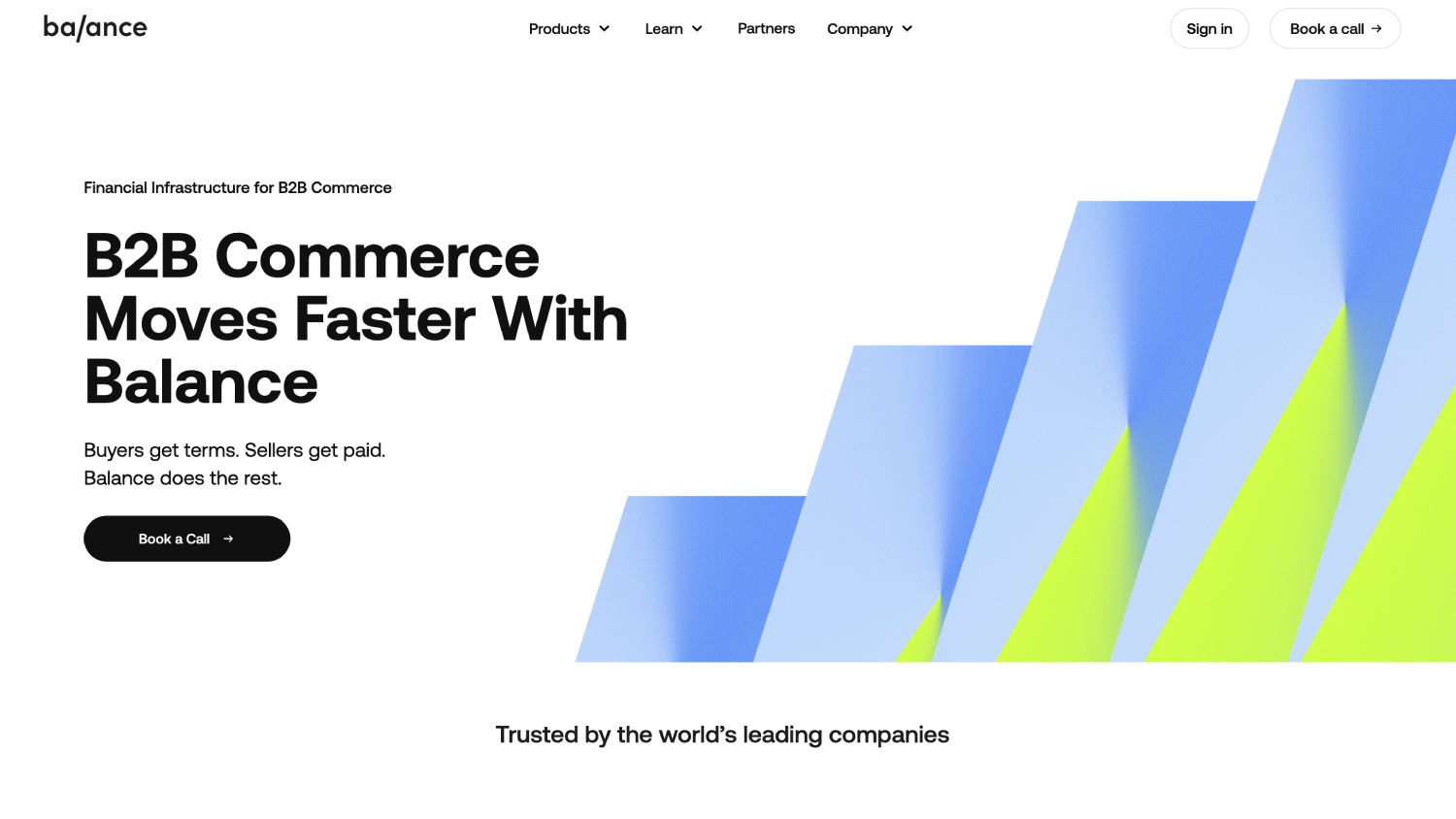
Balance is the clearest API-first trade credit platform for B2B marketplaces. It offers embedded checkout that presents net terms, ACH, wire, and credit card as unified payment options, while underwriting each buyer in real time. Balance takes on the default risk and pays merchants upfront.
Balance is built specifically for B2B marketplaces with high order volumes and complex buyer relationships. Its API lets platforms embed a fully white-labeled payment experience. The underwriting engine uses business credit data, bank account signals, and trade data to produce decisions in seconds, not hours.
Balance publicly targets B2B marketplaces processing significant GMV and does not publish a standard pricing page, which means fee terms are negotiated. Buyers can typically access net-30, net-60, and net-90 terms. Balance is US-based and primarily serves US merchants and buyers.
2. Resolve
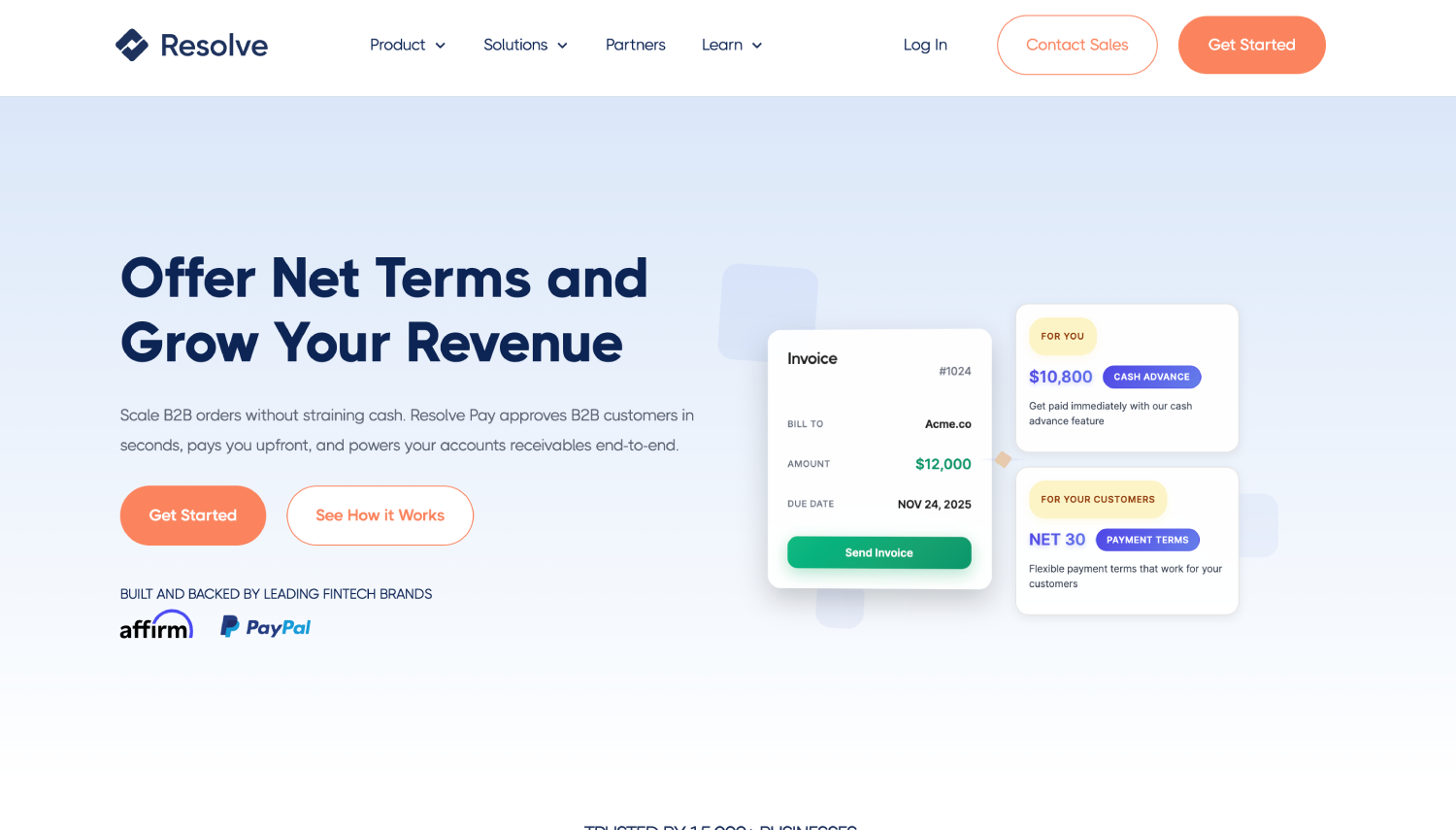
Resolve positions itself as net-terms-as-a-service for B2B sellers, from mid-market manufacturers to wholesale distributors. It integrates with Shopify, QuickBooks, and several ERP platforms, making it accessible without dedicated engineering resources.
Resolve advances up to 90% of invoice value upfront and collects the remaining balance from buyers when the invoice is paid. The company is transparent that it offers non-recourse financing on approved invoices, meaning buyer default does not come back to the merchant. Resolve’s advance rate is publicly documented on its site.
For a SaaS company selling software seats to mid-market businesses on annual contracts, Resolve’s QuickBooks and Shopify integrations mean net terms can be live in days rather than weeks of engineering work. Fee structures are not published as flat rates; Resolve indicates pricing depends on credit term length and buyer risk profile.
3. Slope
Slope is the API-first option most comparable to Balance in developer experience, with a checkout SDK built for B2B SaaS and procurement platforms. It handles buyer underwriting, credit issuance, and collections through a single integration.
Slope’s differentiated angle is speed of underwriting. It claims to deliver credit decisions in under 30 seconds for most business buyers, using machine learning on trade credit, bank data, and business identity signals. Slope also supports embedded BNPL inside third-party SaaS platforms, meaning a procurement software company could surface Slope-powered terms inside its existing product without redirecting buyers to an external flow.
Slope serves US buyers and has expanded into cross-border coverage for select corridors. Pricing is not publicly listed. For SaaS platforms that have already evaluated their embedded finance API options and need credit added to an existing payment stack, Slope is worth a direct conversation.
4. Mondu
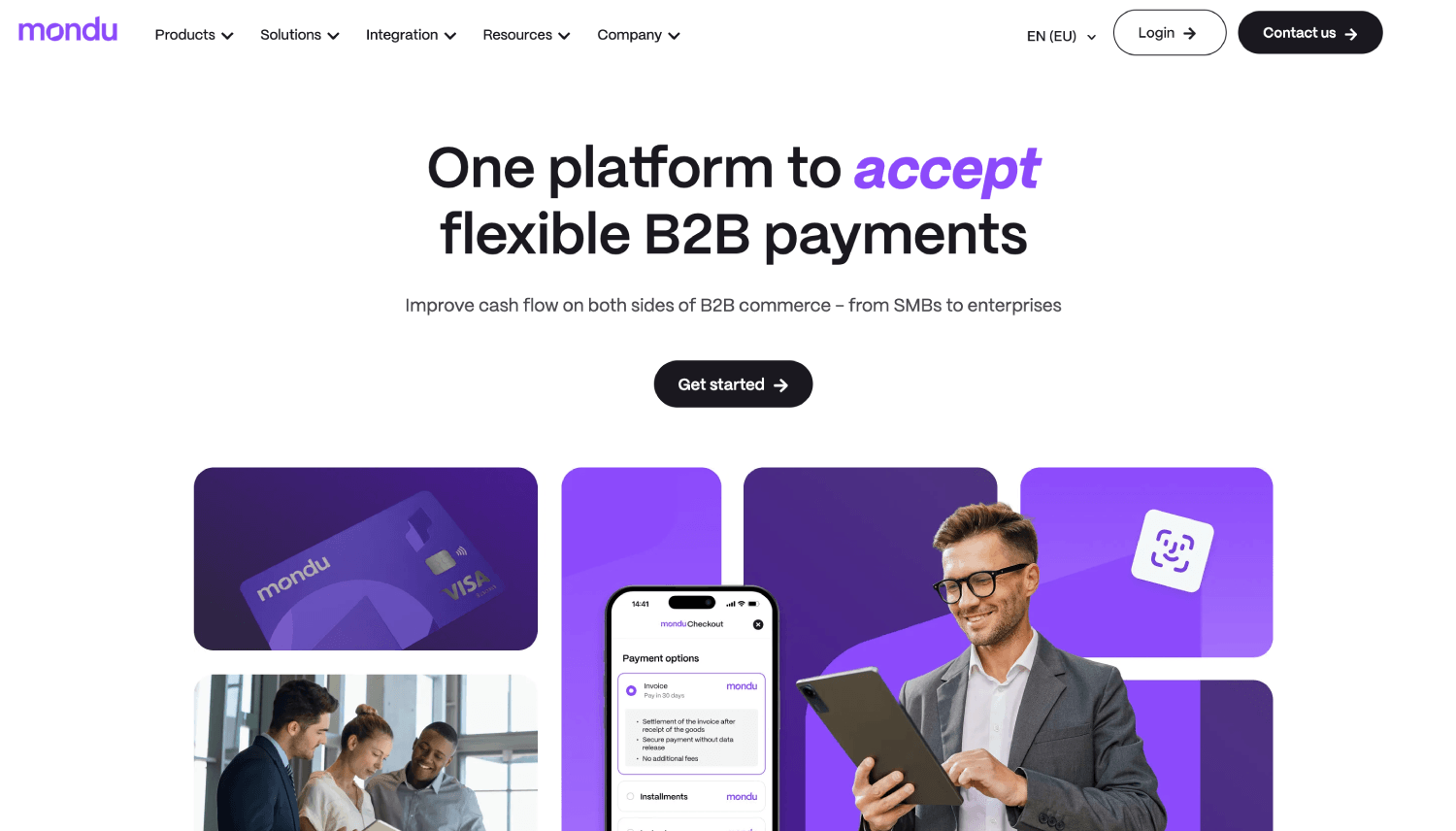
Mondu targets B2B e-commerce companies and marketplaces with embedded BNPL that covers invoice, installment, and pay-later options at checkout. Mondu was founded in Germany but has US operations and serves merchants in multiple markets.
Mondu’s model is non-recourse: it underwrites buyers, takes on default risk, and pays merchants within one to two business days of order confirmation. Its integration includes plugins for common e-commerce platforms alongside an API for custom builds. Mondu’s checkout experience lets buyers choose from multiple payment plans rather than a single net-terms option, which can increase conversion on larger orders.
The installment option is where Mondu distinguishes itself from a pure invoice-financing model. A buyer purchasing $50,000 of software licenses can split into three monthly payments, which reduces friction on large initial commitments without the merchant carrying any of that credit exposure.
5. TreviPay
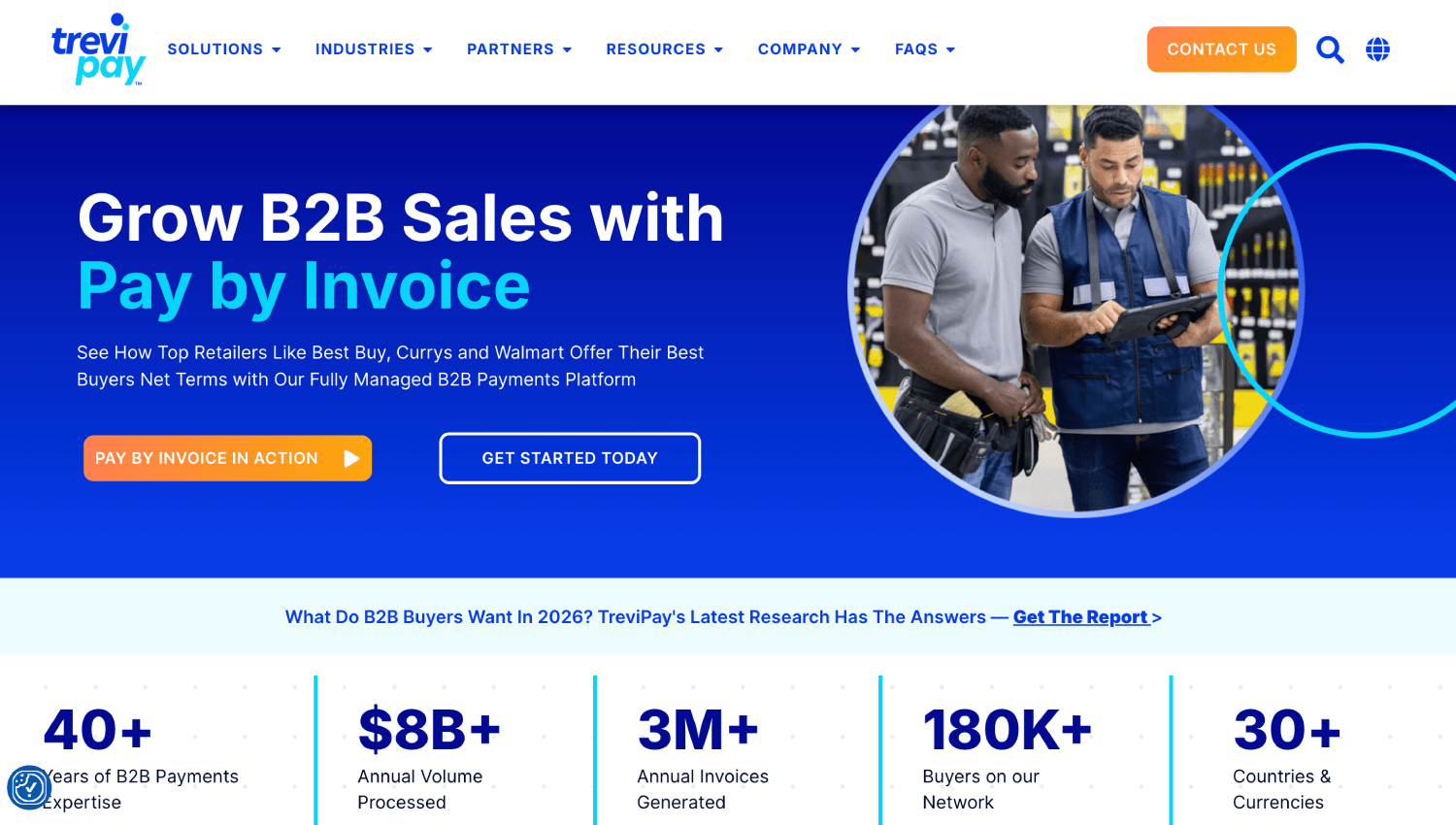
TreviPay is the most established name in this category, operating a managed trade credit network with decades of history in B2B payments. It is less API-first and more of a managed program built around an existing buyer network and credit underwriting infrastructure.
TreviPay works well for enterprise B2B merchants, manufacturers, and distributors that want white-labeled net terms as part of their existing checkout or sales flow. TreviPay handles credit applications, extends lines of credit to approved buyers, and pays merchants upfront. Its buyer network is an advantage: buyers already enrolled in TreviPay for one merchant may get faster approval on another.
For SaaS companies or marketplaces with a developer-first culture and a need for rapid API iteration, TreviPay’s implementation timeline is slower than Balance or Slope. It is the right choice when the selling environment is complex, enterprise, and relationship-driven rather than self-serve.
6. Hokodo
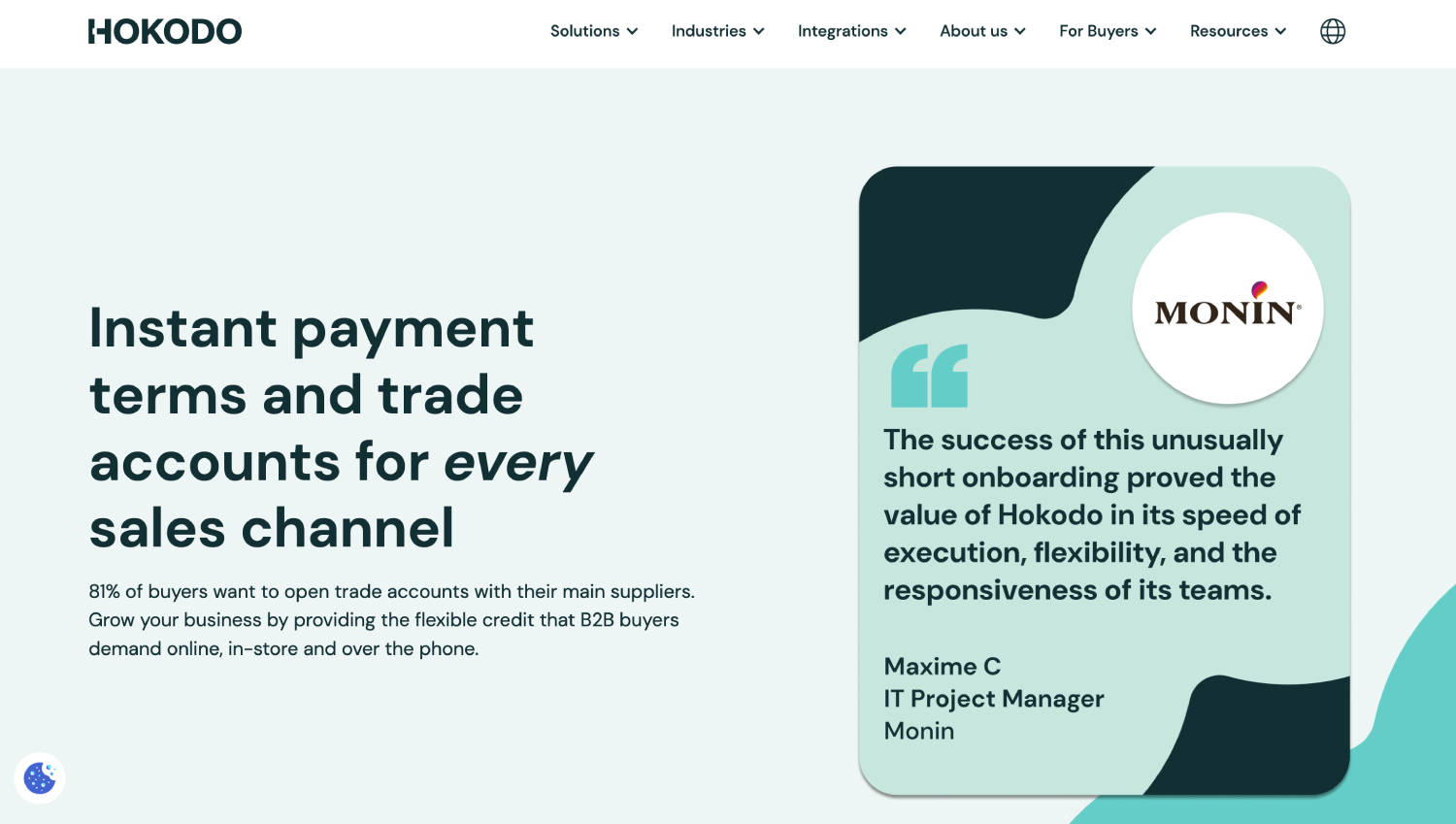
Hokodo offers B2B BNPL built on trade credit insurance as its underwriting backbone, covering merchants in Europe and the UK. Hokodo is not primarily a US product, but it is relevant for marketplaces with significant European buyer bases or for SaaS companies selling cross-border to UK and EU businesses.
Hokodo’s use of trade credit insurance means it can approve a wider range of buyers, including those with thinner credit files, because the risk sits with an insurer rather than Hokodo’s own balance sheet. Merchants get paid upfront after buyer approval. The platform includes an API for embedded integration and supports multiple term lengths.
For a US-headquartered marketplace that processes European orders, Hokodo fills a gap that purely US-centric platforms leave open. It is not a direct replacement for Balance or Slope in a domestic US context, but it belongs on any shortlist that includes international buyers.
7. Behalf
Behalf provides business financing at checkout, offering buyers flexible payment terms funded by Behalf’s own capital. Merchants receive payment quickly while Behalf collects from the buyer over the agreed term.
Behalf’s focus has historically been on small to mid-sized business buyers purchasing from established merchants in manufacturing, wholesale, and distribution verticals. It is less of a developer-first API platform and more of a financing program merchants apply to join. Behalf’s buyer application process tends to be more visible to the end buyer than white-labeled options like Balance or Slope.
For merchants that want a fast path to offering financing without engineering investment, Behalf’s managed approach works. Builders embedding credit into a product experience will likely find the API surface too limited compared to the other options here.
Eligibility and Buyer Credit Limits Comparison Table
| Platform | Primary Market | Integration Type | Buyer Underwriting | Merchant Pays Upfront | Recourse Model | Pricing Transparency |
|---|---|---|---|---|---|---|
| Balance | US | API / SDK | Real-time, automated | Yes | Non-recourse (approved buyers) | Negotiated |
| Resolve | US | API + Shopify/QB plugins | Automated review | 90% advance | Non-recourse (approved invoices) | Partial (rate range) |
| Slope | US + select cross-border | API / SDK | Real-time, under 30 sec | Yes | Non-recourse | Negotiated |
| Mondu | US + Europe | API + e-commerce plugins | Automated + installment options | 1-2 business days | Non-recourse | Negotiated |
| TreviPay | US + global | Managed program + API | Manual + network-based | Yes | Non-recourse | Negotiated |
| Hokodo | UK + Europe | API | Automated (insurance-backed) | Yes | Non-recourse (insurance-backed) | Negotiated |
| Behalf | US | Managed program | Managed review | Yes | Non-recourse | Negotiated |
Note: Credit limits per buyer are not publicly disclosed by any of these platforms and are determined at underwriting based on business credit data, revenue signals, and trade history. Merchants cannot guarantee a specific limit to their buyers at onboarding.
How Do B2B BNPL Platforms Underwrite Business Buyers?
Business buyer underwriting for trade credit is substantively different from consumer BNPL decisioning. Consumer BNPL relies primarily on personal credit scores, thin credit files, and income signals. B2B underwriting layers in business credit bureau data (Dun and Bradstreet, Experian Business, Equifax Commercial), bank account transaction patterns via open banking connections, trade payment history from other vendors, and publicly available business registration and financial data.
Platforms like Slope and Balance have built proprietary machine learning models on top of these data sources to make decisions in seconds. The practical outcome: a buyer visiting a B2B marketplace at 11 PM can request a $50,000 net-60 line and receive a decision before they close the browser tab. This is what makes embedded trade credit materially different from traditional trade credit applications that took days or weeks.
Merchants should understand the implication of automated underwriting: some buyers will be declined, and the platform controls that threshold. If your buyer base has thin business credit profiles, younger companies, or a concentration of sole proprietors buying under a business name, expect higher decline rates. Ask each vendor for their approval rate benchmarks during the sales process. If they will not share a number, treat that as information.
For context on how fraud risk intersects with buyer underwriting, the fraud detection and risk tools category covers identity verification layers that some platforms layer on top of credit checks.
What Does B2B BNPL Actually Cost a Merchant?
No platform in this category publishes a clean flat rate on a public pricing page. Fees are negotiated and depend on three variables: average order value, term length (net-30 versus net-90), and buyer risk profile as assessed by the platform’s models.
Publicly available information from industry sources and vendor disclosures suggests merchant discount rates generally fall between 1.5% and 5% of the financed invoice amount. A net-90 term costs more than a net-30 term because the capital is at work longer. Higher-risk buyer cohorts attract higher fees.
Consider a practical scenario. Say a B2B SaaS company offers annual contracts at $24,000 per year, billed as a single invoice, with net-60 terms. At a 3% discount rate on an embedded BNPL platform, the cost to the merchant is $720 per deal. The alternative is carrying that $24,000 in AR for 60 days, during which the company either funds operations from its own cash or draws on a credit line. If the company’s cost of capital is above 3% annualized, the BNPL fee is the cheaper option even before accounting for collections overhead.
Some merchants pass the fee through to buyers as a financing charge. Check your platform agreement and applicable state lending laws before doing this, as this structure can trigger licensing requirements in certain jurisdictions. This is the same compliance consideration covered in the real cost of compliance for fintech SaaS context.
Which Vendor Fits Which Use Case?
The selection comes down to three distinct operator profiles.
Marketplaces embedding credit into checkout: Balance and Slope are the primary choices. Both are API-first, both offer real-time underwriting, and both white-label cleanly enough that buyers never see the platform name. If your engineering team has already built payment infrastructure and needs to add credit as another payment option in the same checkout flow, these two belong at the top of the shortlist.
B2B SaaS companies selling high-ACV annual contracts to mid-market buyers are a natural fit for Resolve, given its direct integrations with QuickBooks and Shopify and its non-recourse model on approved invoices. If your sales process already involves a CRM and invoicing workflow rather than self-serve checkout, Resolve’s managed approach fits that motion better than a bare API.
Enterprise B2B merchants with complex buyer networks and existing sales teams should look at TreviPay first. The trade-off of slower implementation for deeper buyer network coverage and white-glove program management is worth it at the enterprise level where individual deals are large and buyer relationships are long-lived.
What Are Typical Net Terms in B2B Trade?
Net-30, net-60, and net-90 are the standard intervals, referring to the number of days a buyer has to pay a full invoice after the invoice date. Net-30 is most common in software and services. Net-60 and net-90 appear frequently in manufacturing, wholesale, and construction, where buyers need longer cash cycles to match their own receivables timing.
Early payment discounts (such as 2/10 net-30, meaning a 2% discount if paid within 10 days) exist in traditional trade but are uncommon in the B2B BNPL platform context, where the platform handles collection timing and the merchant is already paid upfront.
Is Affirm a B2B Platform?
Affirm is primarily a consumer BNPL platform. It has made limited moves toward B2B, but its core underwriting model, buyer experience, and product are built around individual consumers, not business entities. Affirm does not appear in serious shortlists for embedded trade credit infrastructure for B2B platforms or SaaS companies. The vendors in this article operate with business credit bureau data, commercial underwriting logic, and invoice-level financing that Affirm’s platform does not replicate.
How to Evaluate Embedded Trade Credit Platforms Before You Sign
The contract terms matter as much as the product experience. Four things to review before signing any platform agreement:
- Recourse language: confirm that approved buyer defaults do not come back to the merchant as clawbacks or charge-backs. Some agreements include carve-outs for fraud or misrepresentation that effectively shift risk back.
- Exclusivity clauses: some platforms restrict merchants from offering competing trade credit products. If you want optionality, negotiate this out before signing.
- Approval rate transparency: ask for documented approval rate benchmarks against a buyer profile similar to your customer base. A 40% approval rate on your specific buyer cohort changes the business case entirely.
- Settlement timing: confirm the exact day count from order confirmation to merchant settlement. “Pays you upfront” can mean same-day or can mean 3 to 5 business days, and that difference matters for cash flow modeling.
If you are at the stage of building out a broader payment infrastructure stack, this decision connects to your overall embedded payments architecture. The embedded payments providers for B2B SaaS comparison covers the broader layer this sits within.
For teams evaluating multiple fintech vendors simultaneously, the structured vendor evaluation framework in how to evaluate a fintech vendor before you sign covers contract, compliance, and operational due diligence in more depth.
Frequently Asked Questions
What does B2B BNPL mean?
B2B BNPL (business-to-business buy now pay later) is a payment financing structure where a third-party platform extends credit to a business buyer at checkout, pays the merchant upfront, and collects from the buyer over an agreed term, typically net-30, net-60, or net-90. Unlike consumer BNPL, B2B BNPL uses commercial credit underwriting, including business credit bureau data and trade payment history, and is designed for invoice-level financing rather than consumer installment loans.
What are the best embedded trade credit platforms for marketplaces?
Balance and Slope are the leading API-first options for B2B marketplaces that need to embed trade credit directly into a checkout flow. Both offer real-time buyer underwriting, non-recourse financing, and white-labeled integration. Mondu is a strong alternative for marketplaces with European buyer exposure. TreviPay suits enterprise marketplace operators with complex buyer networks that benefit from a managed program over a pure API approach.
How does net terms as a service work for SaaS companies?
A net-terms-as-a-service platform integrates into your checkout or invoicing flow, underwrites each business buyer independently, and pays you the invoice amount upfront minus a merchant fee. You have no AR exposure. The platform handles buyer communication, payment collection, and default management. For SaaS companies, this means annual or multi-year contracts can be invoiced with extended payment terms without the company funding that receivable from its own balance sheet.
Who holds the credit license in a B2B BNPL arrangement?
The platform holds the lending license or operates through a licensed banking partner. This is one of the critical distinctions between running your own net terms and using a trade credit platform. When the platform holds the license, the regulatory and compliance burden of extending credit sits with them, not the merchant. Merchants should confirm this structure explicitly in vendor agreements and verify who is the legal creditor on buyer-facing credit agreements.
What approval rates should merchants expect for buyer underwriting?
No platform publishes standard approval rates, as results vary significantly by buyer industry, company age, average order value, and existing business credit profile. Merchants with established mid-market buyers in stable industries generally see higher approval rates than those serving younger small businesses or sole proprietors. During vendor evaluation, ask for approval rate benchmarks against a sample of your actual buyer list. Any vendor unwilling to provide this during a sales process warrants additional scrutiny.
Can merchants pass the B2B BNPL fee through to buyers?
Some merchants structure their pricing to include the platform discount rate, effectively making the financing cost invisible in the purchase price. Others add it explicitly as a financing fee on the invoice. Passing fees through explicitly can trigger state lending law requirements in certain US jurisdictions, depending on how the fee is disclosed and whether it functions as interest. Confirm the legal structure with your legal counsel before implementing buyer-facing financing charges.
Is B2B BNPL the same as invoice factoring?
They achieve similar cash flow outcomes but are structurally different. Invoice factoring involves selling existing receivables to a factor at a discount, typically after an invoice has already been issued. B2B BNPL platforms underwrite the buyer before or at the point of sale and pay the merchant upfront as part of the transaction. Factoring often involves the factor purchasing a portfolio of invoices; embedded trade credit operates invoice-by-invoice with real-time underwriting at checkout. The buyer experience also differs: in factoring, buyers typically know their invoice was sold; in B2B BNPL, the process is often invisible to the buyer.
The Decision Is Simpler Than It Looks
Most operators overthink this shortlist. The actual decision tree has two branches. If you have engineering bandwidth and want credit embedded natively in your product experience, Balance and Slope are the only two platforms worth building on for a US-focused audience. Every other consideration, fee rate, approval speed, white-labeling, is close enough across both that a proof of concept call will determine the fit faster than any additional research.
If you do not have engineering bandwidth or are running a simpler invoicing motion rather than a self-serve checkout, Resolve handles the middle market without a significant technical lift, and TreviPay handles the enterprise end of that spectrum. Mondu fills the gap when European buyers are part of the equation.
The broader insight worth carrying forward is that offering net terms is no longer a financing decision, it is a product decision. The companies that treat embedded trade credit as part of the payment experience, rather than a back-office accounts receivable problem, convert more buyers, grow ACV on larger contracts, and do it without the working capital drag that used to make net terms prohibitive for companies under $50M in revenue. That shift is already underway. The vendors in this list are the infrastructure layer making it possible.