
TLDR
- Tipalti does not publish its platform fee publicly. Pricing is quote-based, and the number Tipalti sales quotes you depends on payment volume, payee count, and which modules you need.
- The platform fee is only one part of what you pay. Per-payment transaction fees and FX markups on cross-border payments are where total cost diverges sharply depending on your payment mix.
- Companies paying mostly US contractors via ACH pay very differently than companies paying international suppliers across 50+ currencies.
- FX spread is the hidden cost most buyers miss during the sales process , a pattern that surfaces repeatedly in community feedback from teams that went live before fully modeling it.
- If your payment volume is under roughly $1M annually or your payee count is low, Tipalti’s pricing structure likely does not make economic sense compared to lighter alternatives.
Tipalti pricing is quote-based across all tiers as of November 2026. The platform charges a recurring platform fee plus per-payment transaction fees, with FX markups applying to cross-currency payments. Total cost depends heavily on payment method mix, payee geography, and which product modules are active. Companies with high international payment volume or complex AP workflows pay materially more than those running simple domestic payouts.
What Does Tipalti Actually Charge?
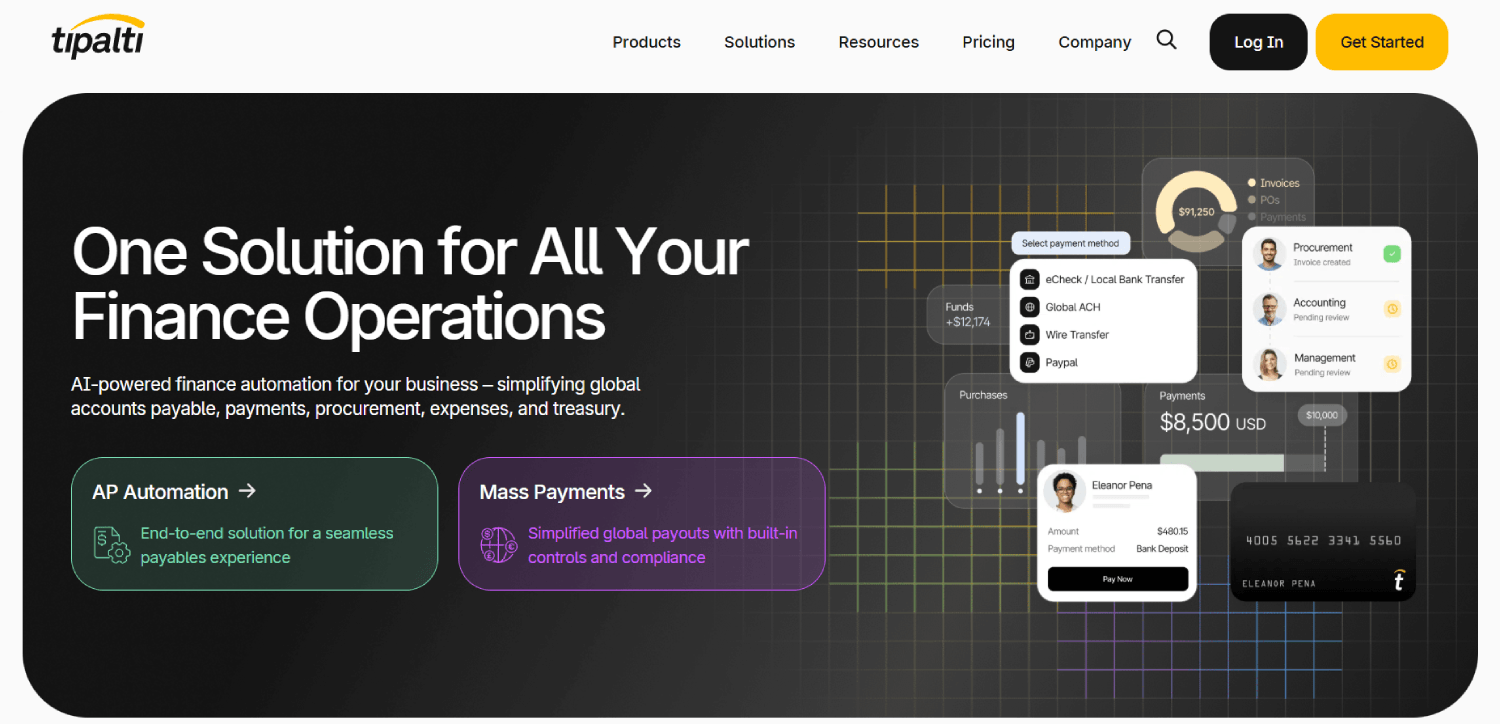
Tipalti does not publish its pricing publicly. As of their pricing page checked November 2026, the company requires a demo and sales conversation before quoting any figures. That means every number in this article comes from what Tipalti has disclosed in public statements, what surfaces in community discussions on platforms like G2 and Reddit’s r/accounting, or what the company describes structurally on its website.
What Tipalti does confirm publicly is the structure: there is a base platform fee (recurring), per-payment transaction fees, and foreign exchange costs. These three components interact, and your total cost is a function of all three, not just the headline platform fee a sales rep mentions early in the process.
Platform Fee
The platform fee is a recurring charge that covers access to the AP automation suite: invoice processing, supplier portal, tax form collection (W-9, W-8BEN), payment scheduling, and reporting. Tipalti does not publicly state what this fee is. Based on what the company describes in its product documentation, fees are structured by tier and scale with usage, but the exact amounts are negotiated during the sales process.
Reviewers on G2 and threads on r/accounting describe the platform fee as difficult to absorb for smaller operations , a pattern concentrated among teams that signed before modeling per-payment and FX costs against their actual payment mix. The company positions itself toward mid-market and enterprise buyers running high payment volumes, which is reflected in how it structures conversations around minimum commitment levels.
Per-Payment Transaction Fees
Tipalti charges per-payment fees that vary by payment method and destination. Tipalti’s website describes support for ACH, wire transfer, PayPal, prepaid debit, and local bank transfers in supported countries. Each method carries a different fee, and those fees are not published on a public pricing page as of November 2026.
The practical implication: a company paying 500 US contractors via ACH each month faces a very different cost structure than a company paying 500 international suppliers via wire in 30 currencies. Per-payment fees compound quickly at scale, and they are the line item that most evaluation teams underestimate during procurement.
FX Markups on Cross-Border Payments
This is where total cost can diverge most significantly. When Tipalti converts USD to a foreign currency for an international payment, it applies an FX markup on top of the mid-market rate. The company does not publish its FX spread publicly as of November 2026.
Community discussions on Reddit and G2 specifically call out FX spread as a cost that becomes visible only after going live, often because procurement teams focused exclusively on the platform fee during the buying process. If 40% or more of your payments are cross-border, the FX component deserves dedicated attention during vendor negotiations.
What Are the Main Cost Drivers for Tipalti AP Automation Pricing?
Understanding Tipalti costs means understanding which variables Tipalti uses to price contracts. There are five that matter most.
The FintechSpecs AP Cost Driver Framework
Finance teams evaluating Tipalti should map their payment operations against five cost dimensions before entering a sales conversation. This framework, which we call the AP Cost Driver Map, helps buyers avoid the common mistake of anchoring on the platform fee while missing the per-transaction and FX costs that dominate real invoices. What makes this framework different from a standard cost checklist is the signal direction: each dimension tells you not just what Tipalti charges on, but whether your specific payment profile tilts toward the expensive or inexpensive end of the range , before you have ever spoken to a sales rep.
| Cost Driver | What Tipalti Charges On | High-Cost Signal | Low-Cost Signal |
|---|---|---|---|
| Payment volume | Number of payments processed per period | High payee count, frequent payments | Low payee count, infrequent cycles |
| Payment method mix | Per-payment fee varies by method | Heavy wire transfer usage | Mostly ACH to US payees |
| International payment share | FX markup on currency conversion | 50%+ of payments cross-border | Primarily domestic payments |
| Module usage | Platform fee scope | Multi-entity, full AP suite | Single entity, basic payout only |
| Contract length | Annual commitment vs. longer term | Month-to-month if available | Multi-year with volume commitments |
Payment Volume and Payee Count
Tipalti’s value proposition is built around automating high-volume AP operations. The more payments you process, the more the fixed cost of the platform fee gets distributed across transactions, and the more Tipalti earns on per-payment fees and FX. At lower volumes, neither side of that equation works in the buyer’s favor.
Module Selection
Tipalti sells its platform in modules. The core AP automation product includes invoice management, supplier onboarding, and payment execution. Additional modules cover procurement, expenses, and global payroll. Each module added to a contract raises the platform fee. Buyers who want the full suite pay significantly more than those running only the payment execution layer.
Multi-Entity Complexity
Companies operating across multiple legal entities, particularly those with subsidiaries in different countries, typically see higher quotes. Multi-entity support is a feature Tipalti markets toward enterprise buyers, and pricing reflects that positioning. If your structure is single-entity with one billing currency, your quote will be lower.
How Does Tipalti Pricing Compare to What Reddit and G2 Users Report?
Most public Tipalti pricing discussions are on Reddit’s r/accounting and r/fintech communities, plus G2 and Capterra review threads. The themes are consistent enough to draw structural conclusions, even without specific dollar figures.
Reviewers who report satisfaction with Tipalti’s cost tend to share a common profile: they were previously managing international payments manually or through a mix of tools, and the consolidation value justified the platform fee. Those who felt the cost was high relative to value tend to be smaller operations that signed contracts before fully modeling per-payment and FX costs against their actual payment mix.
A recurring theme in G2 reviews is that the sales process emphasizes automation benefits and time savings without making the per-transaction and FX cost components equally prominent. That pattern is not specific to Tipalti, but it matters when you are building a budget model. The right evaluation approach is to run your last 12 months of payment data through the AP Cost Driver Map above before you enter pricing discussions.
What Is the Real Total Cost of Tipalti for a Mid-Market Finance Team?
Since Tipalti does not publish pricing, the most useful thing we can offer is a clearly labeled illustrative scenario built from publicly described cost components. This is not Tipalti’s data. It is a worked example using the structural cost model Tipalti describes publicly.
Illustrative Scenario: Series B SaaS Company, 300 Payees
Say a Series B company processes 300 payments per month: 180 domestic (ACH to US contractors) and 120 international (wire to suppliers in 25 countries). Roughly 40% of payment value crosses a currency conversion. The company uses Tipalti’s core AP suite with multi-entity support across two entities.
In this scenario, total cost has three layers. First, the platform fee, which is quote-based but which Tipalti’s market positioning suggests falls in a range material enough that mid-market teams consistently report it as a meaningful line item. Second, per-payment fees across 300 transactions monthly, with higher charges on the 120 wire payments than the 180 ACH payments. Third, FX markup on the portion of international payment value requiring currency conversion.
The key insight from this scenario is that the 40% international share carries the most cost uncertainty. ACH fees are low and predictable. Wire fees are higher but fixed per transaction. FX markup is a percentage of transaction value, so it scales with the size of payments, not just their count. A company paying large supplier invoices internationally pays more in absolute FX cost than a company paying small contractor amounts, even with the same payee count.
This is why finance teams building a Tipalti budget model need three inputs: expected monthly payment count by method, average payment size by method, and percentage of payments requiring FX conversion. Without all three, the number you put in a budget is not reliable.
The same pattern , hidden per-transaction and FX costs dominating total cost over the platform fee , appears across fintech infrastructure more broadly. The analysis in 15 hidden costs killing your fintech SaaS margins covers how these accumulate across payment infrastructure at scale.
Does Tipalti Have Transparent Starter Pricing?
Tipalti does not offer a self-serve option or a published starter tier as of November 2026. Access to the platform requires going through a sales process, which involves a demo, a needs assessment, and then a custom quote. The company’s public website explicitly directs prospective customers to request a demo rather than to a pricing page with posted rates.
This is a deliberate positioning choice. Tipalti competes in a market where contracts are annual commitments with implementation requirements, not month-to-month SaaS subscriptions. The sales-led model is consistent with how the product is used: implementation involves ERP integrations, payee onboarding, tax form collection workflows, and sometimes custom approval chains. That is not a product you configure in an afternoon.
The absence of published pricing does create friction for finance teams that want to build a business case internally before engaging a vendor. The AP Cost Driver Map in the section above is designed to help with that pre-sales modeling step.
How Do Tipalti Fees Break Down by Payment Method?
Tipalti supports multiple payment rails, and each carries a different fee. The company does not publish these fees publicly as of November 2026, but its product documentation confirms the following payment methods are supported: ACH bank transfer, domestic wire, international wire, PayPal, prepaid debit card, and local bank transfer in countries where that rail is available.
| Payment Method | Typical Use Case | Fee Transparency | FX Applies? |
|---|---|---|---|
| ACH (US) | Domestic contractors, US suppliers | Not publicly published | No |
| Domestic wire | Large US supplier payments | Not publicly published | No |
| International wire (SWIFT) | Cross-border supplier payments | Not publicly published | Yes |
| PayPal | Freelancers, contractors globally | Not publicly published | Depends on recipient country |
| Prepaid debit | Payees without bank accounts | Not publicly published | Depends on card currency |
| Local bank transfer | International payees in supported countries | Not publicly published | Yes |
The fee structure across these methods is what makes Tipalti’s total cost difficult to estimate without real payment data. ACH is the cheapest rail. International wire is the most expensive on a per-transaction basis. Local bank transfer can be more cost-efficient than SWIFT wire for certain country corridors, which is why payee geography matters so much in cost modeling.
Finance teams building payout infrastructure for marketplace payments often face similar decisions about rail selection and cost optimization. The comparison of outbound payment and payout APIs for B2B SaaS covers how different platforms structure per-payment costs across these same rails.
What Should You Negotiate in a Tipalti Contract?
Because pricing is entirely quote-based, the negotiation is the pricing conversation. Finance teams that go in without specific ask lists tend to accept the first quote. Teams that model their cost drivers in advance and understand which levers matter can negotiate meaningfully on three dimensions.
Per-Payment Fee Rates by Method
If your payment mix is skewed toward a specific method, ask for volume pricing on that method explicitly. A company running 2,000 ACH payments per month has more negotiating room on ACH fees than one running 200. Tipalti’s pricing structure has room to move on per-transaction rates when volume is committed contractually.
FX Markup
This is the least visible and most negotiable component. Ask Tipalti to disclose the spread it applies relative to mid-market rates, and ask for a reduced spread if your cross-border payment volume is significant. Without asking specifically, you will not get a quoted spread, and you will discover it only by comparing exchange rates post-implementation.
Module Unbundling
If you do not need procurement or expense management, say so explicitly. Contracts that include modules you will not use in the first 12 months are common because sales teams bundle to increase contract value. Push for a contract scoped to your actual current use case with optional module additions later.
Contract structure decisions in fintech infrastructure vendors follow patterns worth understanding more broadly. The 7-point fintech vendor evaluation framework covers how to structure procurement conversations before you are deep in a sales cycle.
Who Should Consider Tipalti and Who Should Not?
Tipalti’s pricing model makes most sense for a specific type of company. Getting this fit wrong in either direction is expensive.
Tipalti Fits Well When
- You process 100+ payments per month with international payees across multiple countries.
- Your team is manually managing tax form collection (W-9, W-8BEN) and payee onboarding, and that overhead has a measurable cost in finance team hours.
- You need ERP integration with NetSuite, Sage, or QuickBooks and want pre-built connectors rather than custom API work.
- You are running multi-entity operations and need consolidated payment workflows across subsidiaries.
- Supplier self-service (payees managing their own bank details and payment preferences) is valuable because your payee base is large enough to make onboarding a real bottleneck.
Tipalti Likely Does Not Fit When
- Your payment volume is under roughly 50-100 payments per month. The platform fee does not amortize at low volumes.
- Your payees are almost entirely US-based with ACH payments. Simpler tools handle domestic-only use cases at lower cost.
- Your team is under 20 people and finance operations are still generalist. The implementation overhead for Tipalti is real and requires dedicated finance team attention.
- You need month-to-month flexibility. Tipalti contracts are typically annual commitments, and exit costs mid-contract are a real consideration.
Bill.com vs Tipalti breaks down which AP automation platform fits which finance team profile, with specific attention to where each vendor’s pricing structure advantages or disadvantages different buyer types.
How Does Tipalti’s Pricing Compare to Alternatives?
Comparing Tipalti against alternatives requires acknowledging that most of its direct competitors also use quote-based pricing. Tipalti, Bill.com, and Trolley all negotiate pricing based on volume and use case. Payoneer publishes some fees publicly but also has variable FX spreads. The comparison is not straightforward.
What differs meaningfully across platforms is the balance between platform fee and per-transaction cost. Tipalti is weighted toward a higher platform fee that buys a broader AP automation suite. Some alternatives carry lower platform fees but higher per-payment charges, which disadvantages high-volume users. Others embed FX revenue more aggressively, which disadvantages cross-border-heavy operations.
Tipalti vs Trolley vs Payoneer for marketplace payouts covers how total cost plays out across payment mix scenarios for each platform.
| Platform | Pricing Model | Published Pricing? | Best Fit |
|---|---|---|---|
| Tipalti | Platform fee + per-payment + FX | No, quote-based | Mid-market to enterprise, high international volume |
| Bill.com | Tiered subscription + per-transaction | Partial, some tiers published | SMB to mid-market, US-focused AP |
| Trolley | Platform fee + per-payment | No, quote-based | Marketplaces and platforms with contractor payouts |
| Payoneer | Variable fees by method and corridor | Partial, some fees listed | Cross-border B2B payments, supplier payouts |
Frequently Asked Questions About Tipalti Pricing
How much does Tipalti cost per month?
Tipalti does not publish monthly or annual platform fees as of November 2026. The cost is quote-based and depends on payment volume, payee count, geographic payment mix, and which modules are included in the contract. Finance teams should model their expected payment volume and international payment share before entering a sales conversation, as these two variables drive the largest share of total cost.
Does Tipalti charge per payment or per payee?
Tipalti charges per payment, not per payee. The platform fee is recurring and covers platform access and module usage. Each payment processed also incurs a transaction fee that varies by payment method, with ACH being lower cost and international wire being higher. FX markup applies additionally to any payment requiring currency conversion. Payee count affects the platform fee structure during negotiation but is not a direct per-unit billing dimension in the same way payment count is.
What is Tipalti’s FX markup and how does it affect total cost?
Tipalti does not publicly disclose its FX spread as of November 2026. The company applies a markup above the mid-market exchange rate when converting USD to foreign currencies for international payments. This markup is a percentage of transaction value, so it scales with the size of payments, not just their count. Companies with large average international payment sizes pay more in absolute FX cost than those making many small cross-border payments. Buyers should explicitly request the FX spread during contract negotiations.
Is Tipalti pricing different for small businesses vs enterprise?
Tipalti targets mid-market and enterprise buyers, and its pricing structure reflects that. Very small businesses or companies with low payment volumes typically find the platform fee difficult to justify relative to simpler alternatives. Enterprise buyers with high payment volumes and multi-entity complexity get more value from the platform, and their volume provides negotiating room on per-payment and FX rates. The company’s minimum commitment levels are not publicly stated but are implied by the sales process and contract structure.
What do Reddit and G2 reviewers say about Tipalti pricing?
Discussions on r/accounting and r/fintech, along with G2 reviews, consistently raise two themes: FX spread as an underappreciated cost that surfaces post-implementation, and the platform fee being justifiable only above certain payment volumes. Reviewers who had been managing international payments manually tend to view the cost positively. Those who signed contracts without fully modeling per-payment and FX costs against their actual payment mix report feeling the total cost was higher than expected. The sales process receives specific criticism for not making FX costs equally prominent to automation benefits.
Are there setup or implementation fees for Tipalti?
Tipalti does not publish implementation fee details as of November 2026. The platform requires integration with existing ERP systems, payee onboarding configuration, and approval workflow setup, all of which carry implementation time. Whether Tipalti charges separately for implementation or includes it in the contract is a negotiation point. Buyers should ask explicitly during the sales process, particularly if they need dedicated onboarding support or custom ERP integration work.
What is Tipalti AP automation pricing for accounts payable specifically?
Tipalti’s AP automation pricing covers invoice capture and processing, three-way matching, approval workflows, payee onboarding and verification, tax form collection, and payment execution. These components are bundled in the core platform fee, though the specific modules included in a base contract versus add-on pricing vary by quote. The AP automation suite is Tipalti’s primary product, and the platform fee for it is the foundational cost before per-payment and FX charges are applied.
What Should You Do Before Requesting a Tipalti Quote?
The most common mistake finance teams make is entering a Tipalti sales process with only a rough idea of what they pay today and no quantified model of what they will pay with Tipalti. Sales conversations then anchor on automation benefits and time savings, and total cost becomes secondary until after the contract is signed.
Before requesting a demo, build a one-page payment profile: monthly payment count by method (ACH, wire, PayPal), percentage of payments crossing a currency conversion, average payment size for international payments, number of legal entities involved, and payee count. That document gives you the inputs to evaluate any quote against your actual cost drivers, not just the platform fee a sales rep leads with.
The AP automation tools category covers more than just Tipalti. Finance teams that want to compare options across a wider set before narrowing to a vendor conversation should start with the full comparison of accounts payable automation tools for finance teams, which covers how different platforms structure costs and which buyer profiles each serves best.
Tipalti is a credible platform for the buyer it is designed for. The risk is not in the product. The risk is in signing a contract built around the wrong cost model. Platform fee, per-payment fees, and FX markup together determine what you actually pay, and each depends on your payment mix in ways that make generic pricing estimates useless for budget planning.